Cork for memoirists
Organize a memoir on a virtual corkboard — capture memories one card at a time, arrange them by time or by theme, and find the shape underneath.
A novelist starts with a plot and works out the scenes. A memoir goes the other way. You start with what actually happened — a conversation in the kitchen, a car ride, a sentence someone said that stuck with you — and the shape has to be discovered, not designed.
That's the hard part. The memories don't arrive in order, they don't announce which ones belong together, and the moment you try to hold all of them in your head at once, half of them slip away.
Cork gives each memory a card. You write them down as they surface, and once they're all in front of you, you can start moving them around until the book underneath them reveals itself. Getting a memory out of your head and onto a card is the whole first act, and it asks nothing of you but honesty.
Capture memories as they come
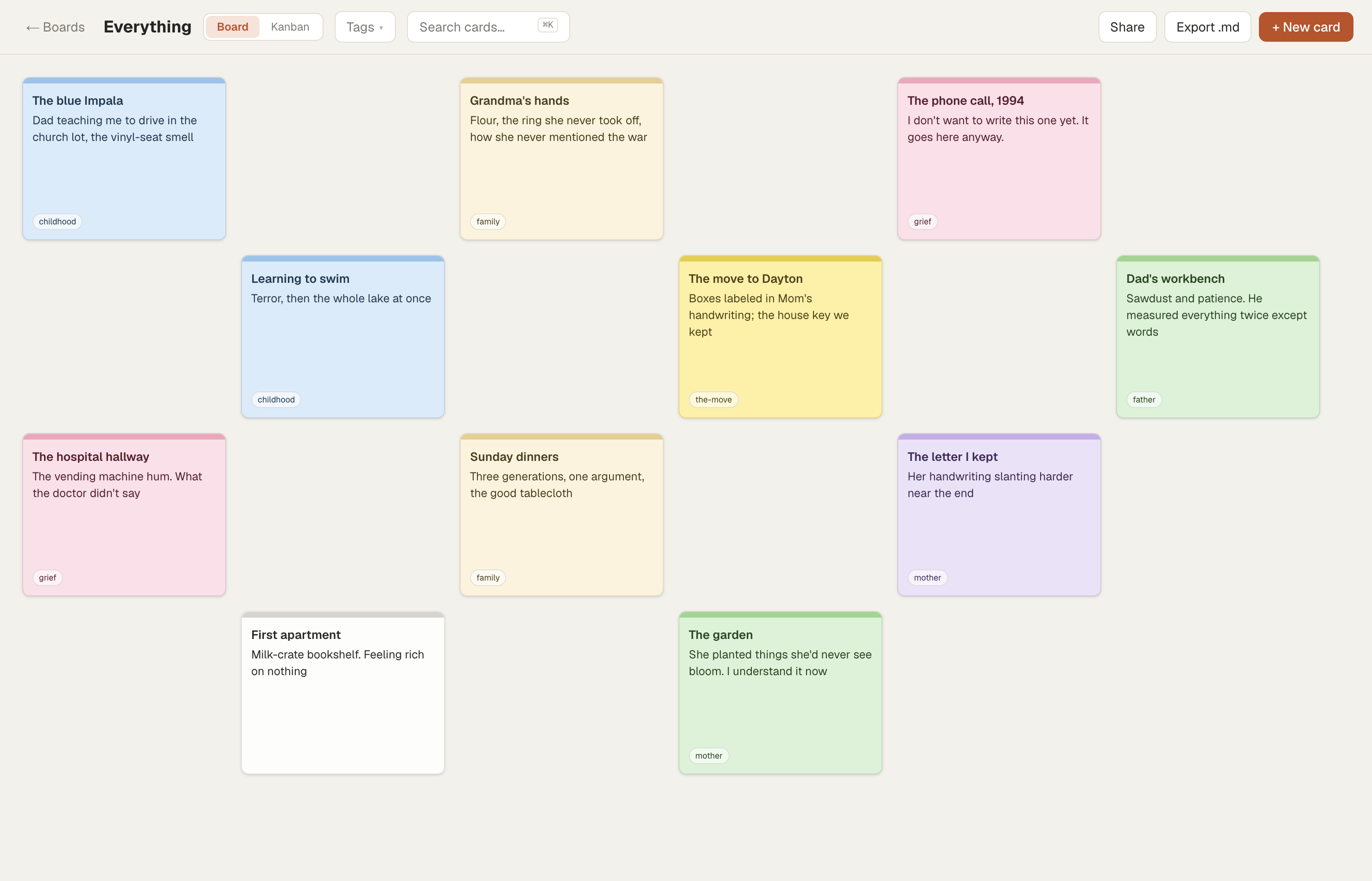
Make one board and call it something plain — "Raw material", "Everything". Then every time a memory surfaces, make a card. One memory per card. Don't sort, don't judge, don't decide yet whether it belongs.
Keep the titles brief and let the bodies be as long or as short as the memory is:
- "The blue Impala" — Dad teaching me to drive in the church lot, the smell of the vinyl seats
- "Grandma's hands" — flour, the ring she never took off, how she never mentioned the war
- "The phone call, 1994" — I don't want to write this one yet. It goes here anyway.
Tag as you go so you can find things later: #childhood, #mother, #the-move, #grief. Tags let you filter the board down to one era or one person when you're ready to look closely, and leave the rest out of view until then.
Arrange by time, then by theme
Here's the quiet power of cards: the same memories can hold two completely different shapes, and you don't have to choose between them.
Flip the board to Kanban and make columns for chronology — "Before", "The years in Ohio", "After" — and slot each memory into when it happened. That's the timeline of your life, and it's useful. But a memoir is rarely just a timeline.
So make a second board — or a second view of the same material — and arrange by theme instead: a cluster for what you inherited, a cluster for what you left, a cluster for what you're still deciding about. The blue Impala might sit under "learning to leave" here, and under "1979" over there. Both are true. Seeing the same memory in two arrangements is often the moment you understand what it's really doing in the book. The arranging guide covers slotting cards between neighbors and piling related ones into stacks.
Find what the book is actually about
At some point you stop capturing and ask the harder question: what is this? Not just what happened, but why it matters.
Now you can take a clustering pass. Drag cards that belong together into the same corner of the board, and let piles form. Drop a handful onto a single card to stack them — a tidy pile you can fan out later. Give each emerging cluster a color, so the themes separate at a glance.
Then link the threads. Type [[ in any card to connect it to another — link three separate memories to a "My mother's silence" card, and its Linked from list becomes the spine of a chapter you didn't know you were planning. If the card doesn't exist yet, the link shows dashed; click it and Cork makes it. That's how a memoir's real subject usually shows up: not announced, but implied by everything that keeps pointing at it. The wiki-links guide explains the linking and backlinks.
When a shape you trust finally emerges, export the board to markdown and use it as the outline you draft from.
Keep the hard material private
Memoir means writing about real people and real wounds, sometimes long before you know whether the book will ever leave your desk.
Boards are private to your account by default. Nothing is visible to anyone else unless you deliberately create a read-only share link for one specific board — to show a trusted reader or an editor — and you can switch that link off whenever you want. There's no shared editing, no feed, no audience. Your words are yours. The cards you're not ready to face can sit in the pile, tagged and waiting, until you are.
What Cork is not
Cork is where you organize the memoir, not where you write it. You draft the prose in Word, Google Docs, Scrivener, wherever you're comfortable, and Cork holds the structure.
It won't import an existing draft, and it doesn't export to PDF or .docx; the one-click export is markdown. There are no reminders or due dates — this isn't a productivity tracker, and a memoir shouldn't be nagged out of you. There's no offline mode yet, so you'll want a reliable internet connection. Cork does one thing very well: it lets you see all your scattered material at once and move it until it makes sense.
FAQ
I don't have an outline yet — is that a problem?
Not at all. That's the situation Cork is built for. You capture memories one card at a time with no order required, and the arranging you do afterward is how the outline emerges. You are meant to arrive without a plan.
How do I keep private or painful material safe?
Every board is private to your account by default and visible to no one else. The only way anything becomes viewable is if you choose to create a read-only share link for a specific board, and you can disable that link at any time. There is no shared editing or public feed.
Can I organize the same memories two different ways?
Yes, and it's one of the most useful things you can do. Keep one board arranged by chronology and another arranged by theme, drawn from the same memories. Seeing a memory sit in two different arrangements often reveals what it actually means in the book.
Do I write the memoir itself in Cork?
No. Cork is for planning and organizing — capturing memories, clustering them, finding the structure. You write the actual prose in whatever writing app you prefer and use Cork to hold the shape.
What can I do on the free plan?
The free plan includes 3 boards and 25 MB of image storage, with no credit card required. That covers a raw-material board plus a board for chronology and one for theme arrangement, which is enough to plan most memoirs. Paid plans add boards and storage if you need them.
Can I add photos to my cards?
Yes. You can drop images directly into a card, which is useful for memoir. Image storage counts toward your plan's limit.
Start free — 3 boards, no credit card. Sign up, write down one memory, and let the rest find their way onto the board.