How to outline a novel with index cards
A practical method for outlining a novel on index cards — what to put on a scene card, how to arrange your acts, and how to spot structure problems.
To outline a novel with index cards, put one scene on each card — a short title plus the four or five things that matter about that scene — then lay the cards out in order on a corkboard or table so you can see the whole book at once. Because each card holds a single idea, you can shuffle scenes, drop a weak one, or slide a new one into the middle without rewriting anything. The board becomes a map you can rearrange until the story's shape looks right, and only then do you start writing prose.
That's the entire method. The rest of this guide is about doing it well: what actually belongs on a scene card, how to arrange them into acts, and how to read the board for problems you can't see in a manuscript.
Why index cards work for outlining
A novel is too big to hold in your head. Eighty scenes, four subplots, a dozen characters who each need somewhere to be — the moment you try to keep all of it in mind, something slips. Index cards fix this by turning the abstract into something physical. Three concepts do the work:
One idea per card. A card is small on purpose. It won't let you cram a whole chapter onto it, so you're forced to reduce each scene to its essence. That constraint is a feature and scenes that can't be distilled down to a few lines probably don't deserve a place.
Rearrangeable. Scenes rarely arrive in the right order. On cards, reordering is a two-second gesture instead of an afternoon of cut-and-paste. You can try the flashback earlier, move the funeral before the argument, pull a scene out entirely and see if the story misses it.
The whole thing is visible. Spread across a board, your novel stops being a scroll you page through and becomes a landscape you take in at a glance. This is where you notice the sag in the middle, the three chapters where nothing changes, the subplot that vanishes for a hundred pages. You see structure because you can see everything.
Paper cards and a corkboard do all of this. But digital is so much more flexible. Cork is an index-card corkboard built for exactly this type of planning workflow, and it adds a few things paper can't (searching every card at once, linking a character to every scene they appear in, no thumbtack holes in your wall). But whether you use Cork or stay analog, everything below works on either.
What goes on a scene card
The most common mistake is writing too much. A scene card is not a draft, it's a label. Keep it to the essentials so the card stays scannable from across the room.
Five things earn their space:
- A title — three to six words you'll recognize instantly. "Nadia identifies the body." Not "Chapter Four."
- POV — whose head we're in. Even if you only have one narrator now, note it; the day you add a second, you'll be glad it's already there.
- What the POV character wants in this scene — the small, immediate goal, not their life's ambition. "Get the harbormaster to admit the boat went out that night."
- The turn — what goes wrong, what's revealed, or what changes. A scene without a turn is usually two scenes or none.
- The hook out — what's different at the end, or the question that pulls the reader to the next card.
Location, time of day, or a subplot tag can go on too if they help, but resist the urge to write dialogue or description — those belong in the draft. If a great line comes to you, put it on the back of the card (or the bottom of the card in Cork) and move on.
An example: eight scene cards
Abstract advice is easy to nod along to and hard to use, so here's a concrete example: a small literary mystery called Salt.
Premise: Nadia Reyes, a marine biologist, comes home to the fishing village she left at eighteen after her younger sister Cass vanishes from a boat one night. The town has decided the sea took her. Nadia doesn't believe the sea works alone.
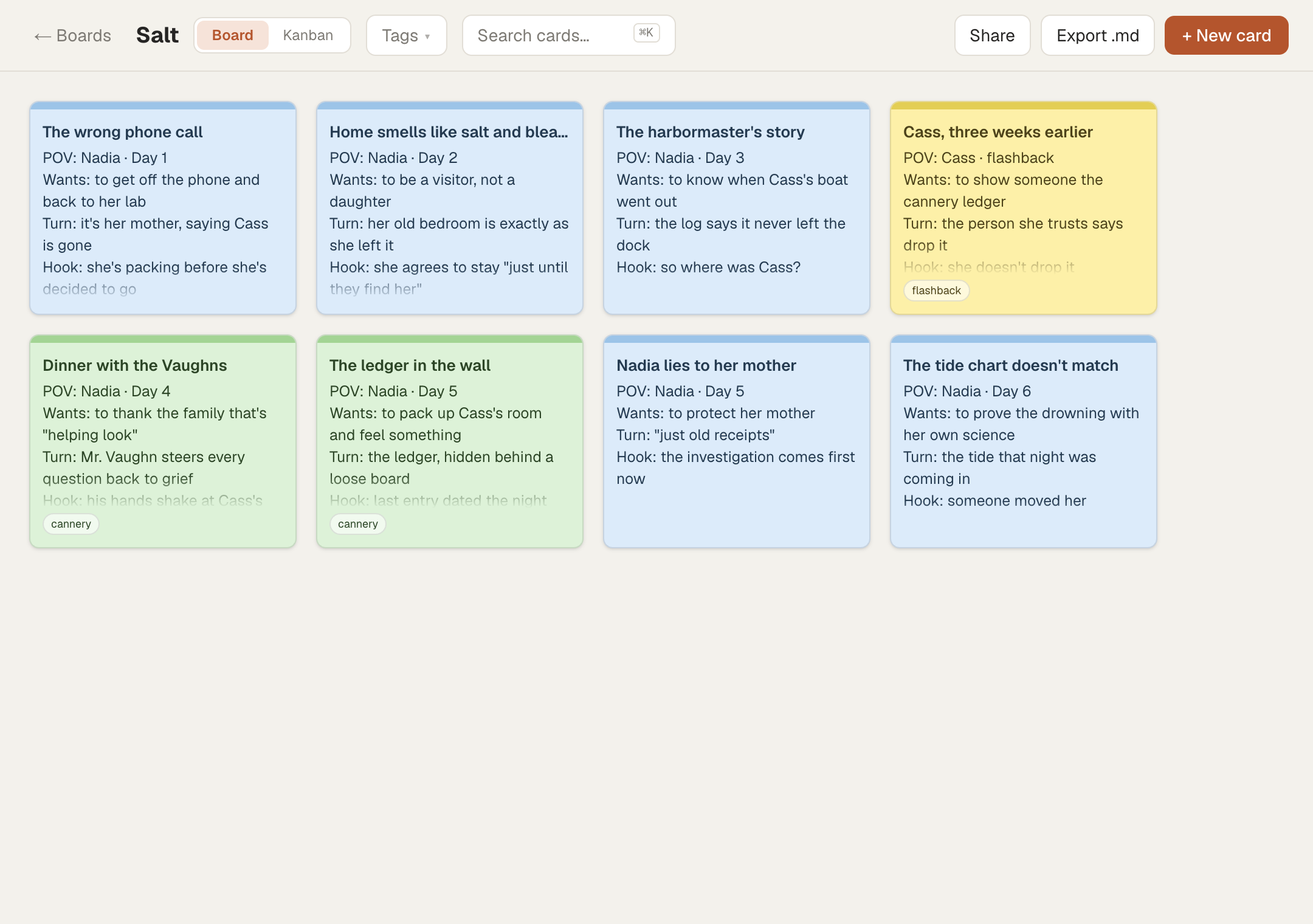
Here are eight cards from the opening third, as they'd appear on the board.
The wrong phone call
POV: Nadia · Day 1
Wants: to get off the phone and back to her lab
Turn: it's her mother, who hasn't called in six years, saying Cass is gone
Hook: Nadia is already packing before she's decided to go
Home smells like salt and bleach
POV: Nadia · Day 2
Wants: to be a visitor, not a daughter — in and out
Turn: her old bedroom is exactly as she left it; her mother kept it
Hook: she agrees to stay "just until they find her"
The harbormaster's story
POV: Nadia · Day 3
Wants: to know when Cass's boat went out
Turn: the log says the boat never left the dock that night
Hook: so where was Cass's boat, and where was Cass?
Cass, three weeks earlier
POV: Cass · flashback
Wants: to show someone what she found in the cannery ledger
Turn: the person she trusts tells her to drop it
Hook: she doesn't drop it
Dinner with the Vaughns
POV: Nadia · Day 4
Wants: to thank the family that's "helping look" for Cass
Turn: Mr. Vaughn owns the cannery, and he steers every question back to grief
Hook: Nadia notices his hands shaking when Cass's name comes up
The ledger in the wall
POV: Nadia · Day 5
Wants: to pack up Cass's room and feel something
Turn: she finds the cannery ledger hidden behind a loose board
Hook: the last entry is dated the night Cass disappeared
Nadia lies to her mother
POV: Nadia · Day 5
Wants: to protect her mother from what she's starting to suspect
Turn: she says the ledger is "just old receipts"
Hook: it's the first time she chooses the investigation over her family
The tide chart doesn't match
POV: Nadia · Day 6
Wants: to prove the drowning story with her own science
Turn: the tide that night couldn't have carried a body out — it was coming in
Hook: Cass didn't drift away. Someone moved her.
Notice what those cards do and don't do. Every one has a want and a turn. None of them contains a paragraph of prose. You could read all eight in thirty seconds and know the shape of the opening. You could just as easily pull out "Dinner with the Vaughns," decide it's too early, and slot it three cards later without touching anything else.
In the screenshot, notice also the two POV colors: the Cass flashback card is doing different work from the Nadia cards. That's a cue we'll use in a moment.
How do you arrange cards into acts and sequences?
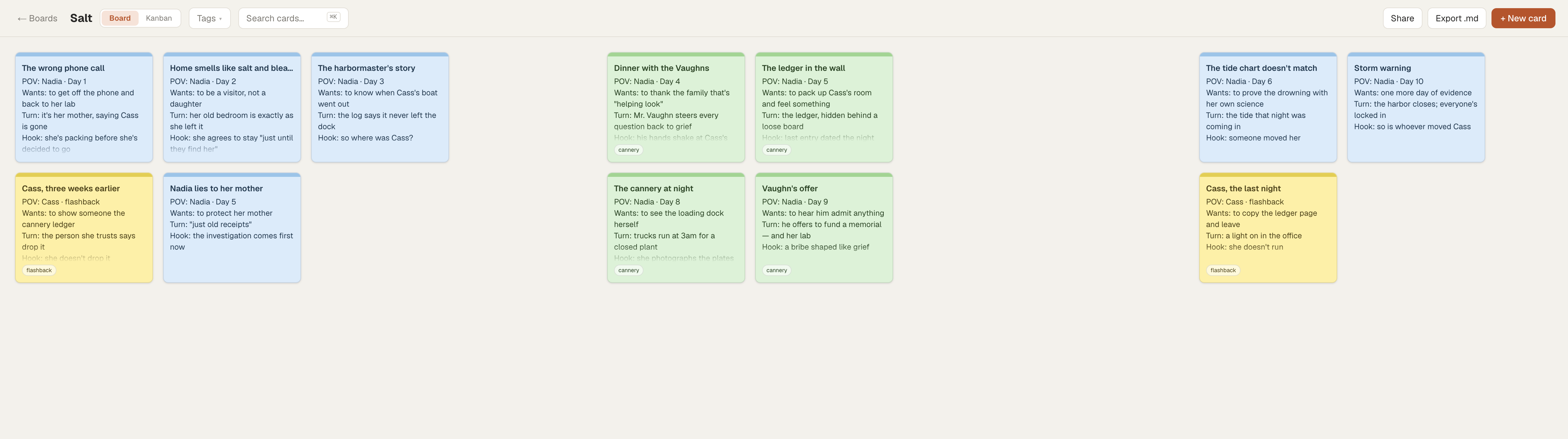
Once you have a pile of scene cards, arranging is the act of creating an outline. Lay them left to right in reading order. Then look for the natural clumps. Most novels fall into three or four big movements, and within those, you'll find sequences of three to six scenes that belong together (a heist, a courtship, a descent).
Two layouts are useful here, and Cork makes both easy to achieve digitally:
Free-form board. Cards flow left to right in rows, the way you'd read them, with a little vertical space between acts. This keeps the whole novel visible and is best for the early, messy stage when you're still discovering the order. On a physical corkboard you use the whole wall; in Cork's free-form board view the board grows as you drag toward the edges, so you never run out of room, and cards snap to a grid so it doesn't turn into chaos.
Columns. Once the acts firm up, a column per act (or per sequence, or per chapter) makes the structure explicit. Cork's kanban view gives you named columns you can reorder by dragging the header — handy, because acts and chapters have a way of swapping places. You can name a column "Act I," fill it, and see at a glance that it holds nineteen cards while Act II holds six. That imbalance is information.
Don't agonize over which act a scene "really" belongs to. Just put it somewhere, look at the board, move it if it's wrong.
How can you find structure problems just by looking at the board?
Here's what a corkboard does that a manuscript can't. Step back and read the board as a picture. You can see the shape of your story, without having to read the entire thing chronologically.
Color-code your POVs and subplots. Give each viewpoint character a color, or each subplot a color, and the shape of your book jumps out. If the romance subplot is yellow and there's a yellow card in chapter two and then no yellow again until chapter fifteen, you've found a thread you dropped. Physical cards come in colors, or you dot them with markers; Cork lets you give every card a color, so recoloring to test a theory is a click, not a trip to the store.
Look for gaps and clusters. A long run of one color means a subplot has taken over. A stretch with no turns — every card just "characters talk" — is a sag readers will feel. Five high-tension cards back to back may be exhausting; a run with none may be dull. You can see your pacing visually.
Read the wants. Scan the "wants" line down the board. If three scenes in a row want essentially the same thing, they might be one scene. If a card has no want at all, ask what it's for.
Watch character usage. Tag scenes by which characters appear in them. In Cork, tags let you filter the board to just one character's scenes. Turn on the "Cass" tag and you might instantly see she's absent for the entire second act, which is either a problem or a deliberate choice. Either way, now you know.
Stacking related cards
Sometimes several cards are really one idea, or you're holding variants of a scene you haven't chosen between. Pile them. On a corkboard that's a literal stack under one pin; in Cork you drop one card onto another's center and they become a stack with a count badge, fanning out when you click.
Stacks are good for research attached to a scene, three versions of an ending, or "these four beats are a montage." They keep the board readable — one tidy pile instead of clutter — while the detail stays a click away.
For a long or interconnected book, it's worth linking cards as well as stacking them. Cork's wiki-links let a scene card point to a character card, and every scene a character appears in shows up under that character's backlinks automatically. This is one thing you can't do with paper cards.
When do you stop outlining and start writing?
Outlining is comfortable. It feels like progress and never risks a bad sentence, which is exactly why it's easy to hide in. Stop when the board can answer three questions: Do you know the first scene? Do you know, roughly, the last? Can you see a path — even a rough one — between them?
You don't need every card filled in. Gaps are fine; a card that just says "something goes wrong in the cannery — figure out what while drafting" is honest planning, not failure. A good sign you're ready: you feel a pull to actually write a particular scene. Go write it. The outline will still be there, and the draft will teach you things the outline couldn't.
For pantsers: outline after you draft
If planning kills the fun for you, cards can still be useful. Just run the method backward. Draft first, by instinct. Then, once you have a messy manuscript, make one card per scene after the fact and lay them out. Now you can see the shape of the thing you actually wrote, spot the repetitions and the dropped threads, and rearrange before revising.
This "reverse outline" is one of the best revision tools there is, and it converts a lot of card-skeptics. When you write first, cards don't map where a story is going, they show you where it's been. Use Cork to add your scenes as cards, tag by POV, and get a high-level view of your story's structure. When you're done, one click exports the whole board to markdown to take back into your writing app. Your words are always yours.
Try it
Buy a pack of index cards, some push pins, and a corkboard, write out a few scene cards for something you're working on, and stick them to the wall. You'll feel the power of this method within an hour.
If you'd rather not deal with erasers and rewriting cards, want to easily search across your ideas, link characters to scenes, and work on the go on your phone, Cork is free to try — three boards on the free plan, $19 a year if you outgrow it.
Either way, the best way to start your novel is to start it.