Scene cards: what goes on one and how to write cards that stay useful
What a scene card is and what goes on one, field by field, with clear examples and the bad-card versus fixed-card pairs that separate a card from clutter.
A scene card is a single index card that holds one scene from your story, reduced to the few details that make it work. What goes on it: a short title you can recognize at a glance, the point-of-view character and when the scene happens, what that character wants, the turn (what changes or goes wrong), and the hook that pulls a reader to the next scene. You keep it short enough to read at a glance and limit it to one scene per card, so you can shuffle, cut, and reorder your whole book without rewriting a word.
That card is the atom of the whole method. If you want to learn about the board-level view (laying cards into acts, reading the shape of the book, spotting a sagging middle) start with our guide to the board-level method. This guide stays zoomed all the way in on one card: what a scene actually is, what each field is doing, and how to write cards that continue to earn their place as you write.
What counts as a scene?
Before you can put a scene on a card, you have to know where one starts and stops. Here's a working definition of a scene:
A scene is a stretch of story where someone wants something and the situation moves.
Change happens. Somebody enters the scene in one state and leaves it in another, even if the change is small and quiet.
That gives you two quick tests. Is there a person with a want, however modest? And is the situation different at the end than at the start? If nothing moves, you have a description or a transition, and it probably belongs folded into a preceding or following scene. The change can be tiny. A character walks into a kitchen meaning to apologize and walks out having lied instead. That is a full scene.
Scene versus chapter
Keep these separate in your head. A scene is a unit of story. A chapter is a unit of packaging. One chapter might hold three scenes, or a single long scene might run across two chapters. When you first create your cards, you add scenes to your cards, one per card, and worry about chapter breaks later. Card the story first.
The anatomy of a good scene card
Scene cards have five core fields. Once you know what each field does, you'll be able to more quickly and easily lay out your story. As writing a good scene card becomes more natural, you'll be able to stay focused on the story instead of the mechanics of the method.
The title is a handle
The title is a handle you grab the scene by. Three to six words that snap the whole scene back into your mind the instant you read them. "The dry run goes wrong" tells a stranger nothing and tells you everything. "Chapter Nine" is a filing label, worthless the moment you move the card.
POV and time are sorting keys
Whose head are we in, and when does this happen. Note the point-of-view character even if you only have one narrator today, because the day you add a second you will want to sort by it. Time can be a day count, a date, or a marker like "flashback." These two fields are how you sort the deck later: show me all of Teo's scenes, show me everything on Day 2. They earn their place on your cards even when nothing dramatic lives on them.
The want is the engine
The want is the small, immediate goal that drives the character through this specific scene. The thing they are trying to get or make happen in the next small block of story. "Get Doyle to extend the deadline." "Leave the party without being seen." A scene with a clear want has an engine. A scene with no want tends to drift, and you will feel it drift on the page.
The turn is the proof
The turn is what changes: what goes wrong, what gets revealed, what the character decides. It is the proof that the scene had to exist. A scene where a character wants something, gets it easily, and leaves unchanged is usually two scenes or none. When you cannot name the turn, you have found a scene that is not pulling its weight, and the card just told you so before you wasted a week drafting it.
The hook is the thread forward
The hook is what is different at the end, or the question that makes a reader need the next card. It is the thread that ties this scene to the one after. Crucially, though, it is not a cliffhanger every time. Sometimes just a shift: a decision made, a door now open, a suspicion planted. If you read the hooks straight down the board and they pull you along, your momentum is probably sound.
One optional field: where
The board-level guide noted that location can go on a card when it helps. For most stories it's not necessary. But if your book moves through charged spaces where the setting drives the tension (a heist through guarded rooms, a road trip, a house being sold), add a Where: line and use it. In the example below the whole plot is about getting into one specific room, so location is load-bearing and stays on every card.
An example: six cards from a heist story
Sometimes it's easier to fully understand a new process with a clear example. Here's one from a heist story called Nightwork.
Premise: Marisol Vega gave up safecracking five years ago after a job left her with a tremor in her right hand. Her younger brother Teo, deep in debt to a collector named Doyle, has pledged the one thing their father left them, his watch, as collateral. Doyle sells it in a week. Marisol has that week to open Doyle's vault and take the watch back.
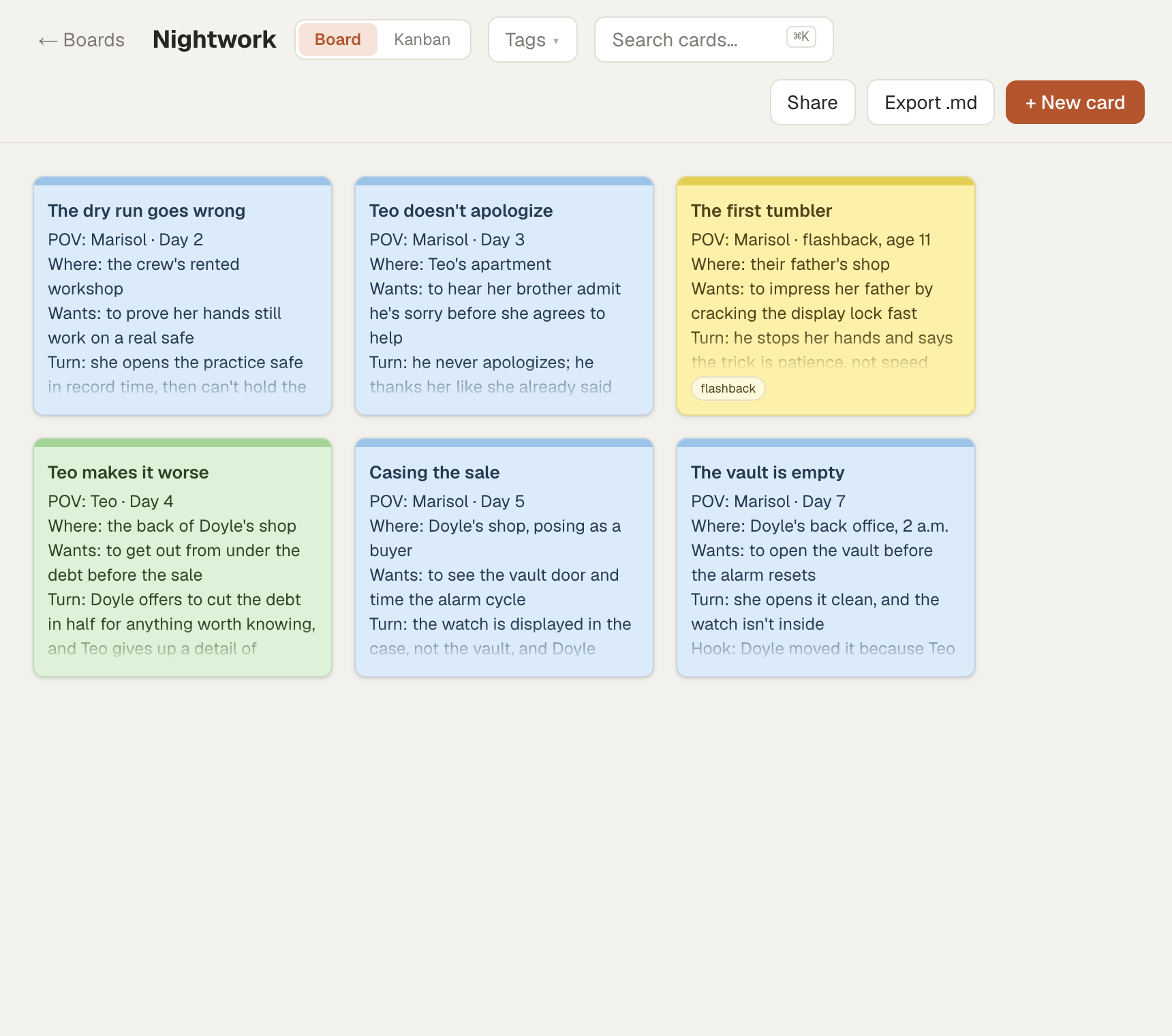
Here are six cards, chosen to show range: an action scene, a quiet scene, a flashback, and a subplot scene from a second point of view.
The dry run goes wrong
POV: Marisol · Day 2
Where: the crew's rented workshop
Wants: to prove her hands still work on a real safe
Turn: she opens the practice safe in record time, then can't hold the pick steady afterward
Hook: she tells no one the tremor is worse than it was
Teo doesn't apologize
POV: Marisol · Day 3
Where: Teo's apartment
Wants: to hear her brother admit he's sorry before she agrees to help
Turn: he never apologizes; he thanks her like she already said yes
Hook: she realizes she agreed to the job without ever deciding to
The first tumbler
POV: Marisol · flashback, age 11
Where: their father's shop
Wants: to impress her father by cracking the display lock fast
Turn: he stops her hands and says the trick is patience, not speed
Hook: it's the last real thing he taught her, and it's the thing she keeps forgetting
Teo makes it worse
POV: Teo · Day 4
Where: the back of Doyle's shop
Wants: to get out from under the debt before the sale
Turn: Doyle offers to cut the debt in half for anything worth knowing, and Teo gives up a detail of Marisol's plan
Hook: he's now selling out the person saving him, and he knows it
Casing the sale
POV: Marisol · Day 5
Where: Doyle's shop, posing as a buyer
Wants: to see the vault door and time the alarm cycle
Turn: the watch is displayed in the case, not the vault, and Doyle catches her looking at it
Hook: he smiles at her and calls her by name
The vault is empty
POV: Marisol · Day 7
Where: Doyle's back office, 2 a.m.
Wants: to open the vault before the alarm resets
Turn: she opens it clean, and the watch isn't inside
Hook: Doyle moved it because Teo told him she was coming
You can read those six cards in half a minute and know the shape of the story. Every card has a want and a turn. None holds a paragraph of prose. You could pull "The first tumbler" out, decide it lands better right before the vault, and slide it there without touching another card.
Common mistakes and how to address them
Most weak cards fail in one of three recognizable ways. Here is each one as a before and after, so you can spot yours.
The card that's a summary
A summary card tries to hold the whole sequence on one card. It is really several scenes wearing a trench coat.
Bad:
The heist
POV: Marisol
Marisol assembles the crew, they case Doyle's shop over several days, gather tools, and finally break into the vault on the night of the sale, only to find the watch is gone.
That is four scenes. Split it, and give each its own turn. The last beat alone becomes:
The vault is empty
POV: Marisol · Day 7
Where: Doyle's back office, 2 a.m.
Wants: to open the vault before the alarm resets
Turn: she opens it clean, and the watch isn't inside
Hook: Doyle moved it because Teo told him she was coming
One card, one scene, one turn. Stick to that rule so each card becomes a more flexible, malleable, moveable chunk of story.
The card with no turn
A no-turn card describes an event without a change. It looks complete and does nothing.
Bad:
Marisol and Teo have coffee
POV: Marisol · Day 3
Wants: to talk to her brother
Turn: they talk
Hook: she leaves
"They talk" is not a turn. Ask what breaks or shifts, then put that in the field:
Teo doesn't apologize
POV: Marisol · Day 3
Where: Teo's apartment
Wants: to hear her brother admit he's sorry before she agrees to help
Turn: he never apologizes; he thanks her like she already said yes
Hook: she realizes she agreed to the job without ever deciding to
Same action, but now something moves. Marisol has come to a startling realization and more of Teo's character (and their relationship) has been revealed.
The card written as prose
A prose card is a card you started drafting. The description is good, which is exactly the trap: you are writing the book when you should be giving it shape.
Bad:
The dry run
POV: Marisol · Day 2
The safe was older than she'd expected, a scarred dial that ticked under her fingers like a slow heart. She breathed out, found the first contact point, and for a moment her hand was twenty-eight again and nothing hurt.
Evocative, but useless on a board, because you cannot scan it and you cannot move it without rereading it. Save the line and put it somewhere else, then strip the card down to necessary fields:
The dry run goes wrong
POV: Marisol · Day 2
Where: the crew's rented workshop
Wants: to prove her hands still work on a real safe
Turn: she opens the practice safe in record time, then can't hold the pick steady afterward
Hook: she tells no one the tremor is worse than it was
If a good line arrives while you card, keep it, just not on the front. In Cork, drop it in the card body where it opens full-screen, out of the way of the board. Or create a new board (or stack of cards off to the side) for lines of prose you want to save for later.
How detailed is too detailed?
The rule of thumb: a card is too detailed the moment you cannot take it in at a glance. If reading the card takes more than a second or two of mental effort, you've overpacked it. Fields should be short phrases, not sentences with clauses. Write "get Doyle to extend the deadline," not "Marisol attempts, through flattery and veiled threat, to persuade Doyle to grant Teo more time." Gaps are fine too. A card that says only "something goes wrong at the sale, figure out what while drafting" is honest planning. Keep the map readable.
When it makes sense for a scene card to have extra material
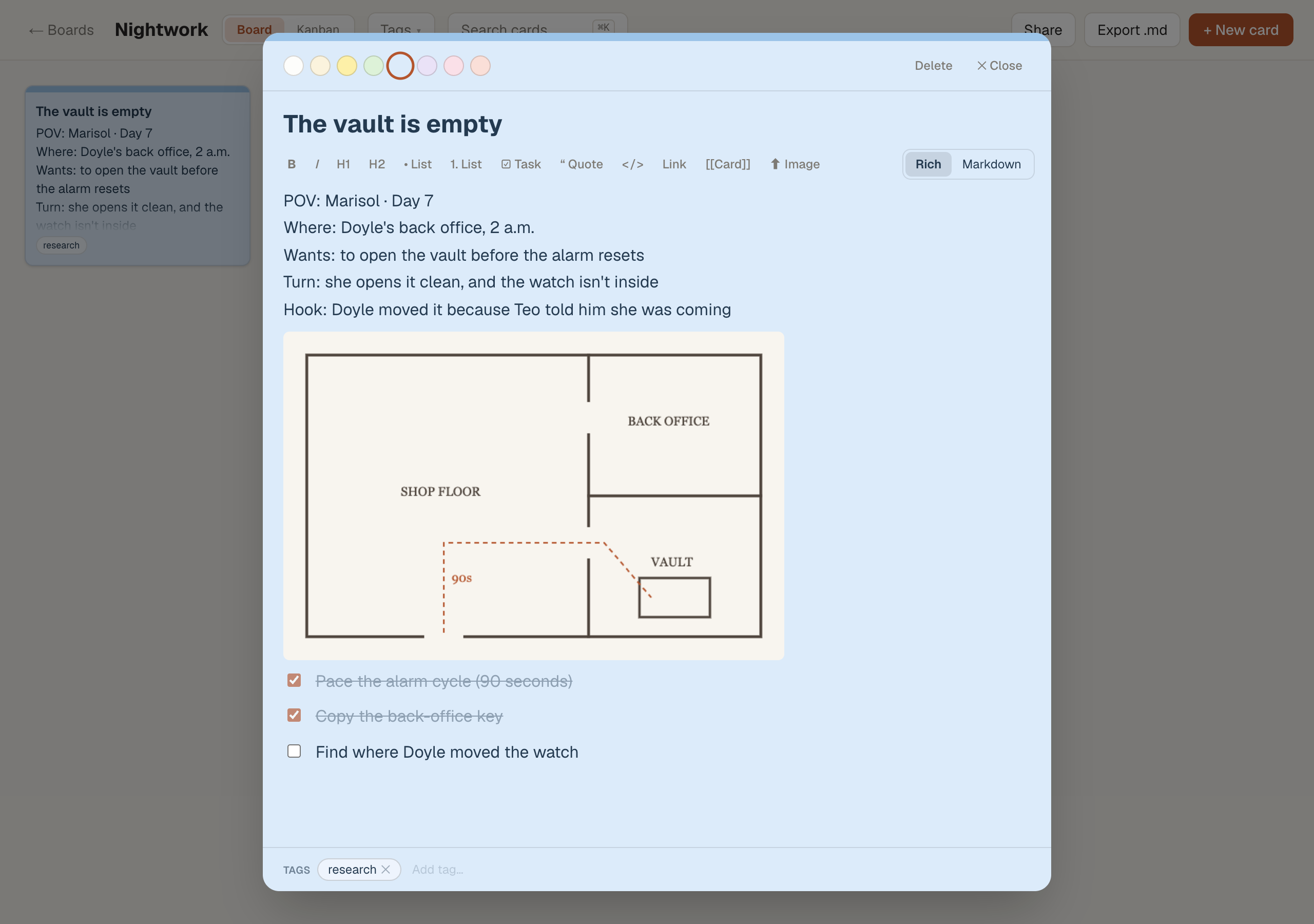
Some scenes need more than five lines behind them: a heist has a floor plan, a period piece has research, a location has a photo you want to write from. The card face stays short and the extra material rides underneath.
On paper you clip a note to the back or pin a small stack under one card. In Cork you have two moves. Open the card and put the material in its body, which holds markdown, inline images, and checkable lists, so a floor plan and a step list can live inside "The vault is empty" without cluttering the board. Or stack related cards: drop one onto another and they fan into a pile with a count badge, good for three versions of an ending or a scene plus its research.
For a longer story or book, use internal links to connect different types of cards. A wiki-link from a scene card to a character card means every scene that character appears in shows up under their backlinks, and tags let you filter the board to one thread. The card stays a quick reference, while the depth remains a click away.
A scene card template you can copy
Here is the whole thing in a form you can copy and paste onto a blank card:
[Title: 3 to 6 words you'll recognize instantly]
POV: [character] · [Day n / date / flashback]
Where: [location, if setting drives the scene, otherwise skip]
Wants: [the immediate goal in this scene, not the life goal]
Turn: [what changes, goes wrong, or gets revealed]
Hook: [what's different at the end, or the question pulling forward]
Fill it top to bottom. If you get stuck on the turn, that is the card telling you the scene may not be a scene yet. If you get stuck on the want, ask who this scene belongs to. The template is small on purpose; the constraints force you to think through what is necessary to drive your story forward.
Try it
Grab a pack of index cards and write out five scenes from whatever you're working on, one per card, using the template above. You'll feel which ones have a turn and which ones aren't fully there yet.
For a more flexible, digital approach, Cork is free to try: three boards on the free plan, no credit card.