
The snowflake method: how it works and where index cards fit in
An easy-to-follow walk through the snowflake method for novels, its ten stages grouped for clarity, and how the scene list becomes index cards you can move.
The snowflake method is a way to plan a novel by starting with a single sentence that sums up the whole book, then expanding it through a series of passes. The sentence becomes a paragraph, the paragraph becomes a page, the characters get their own summaries, and you keep growing the outline until you have a full scene list ready to draft. Novelist Randy Ingermanson designed it, and the name comes from a shape in geometry, the snowflake curve, where a plain triangle becomes intricate by adding detail at every step. The concept behind the method is that a story, like that shape, is easier to build outward from a clear center than to assemble all at once.
This guide walks through the method, including the parts that frustrate people, and then shows how it can work with index cards. If you already plan on using cards, the payoff arrives late, at the scene-list stage, which produces exactly the cards you would build anyway. That makes the snowflake method and the corkboard two halves of one workflow rather than rival systems.
Who created the snowflake method, and what is the core idea?
Randy Ingermanson, a novelist with a background in physics, laid the method out on his site AdvancedFictionWriting.com, and it has circulated among writers for years. Everything else is elaboration on a single principle. Here is that principle at its most basic:
Write the smallest honest version of your story, then expand it in ordered passes, letting each pass surface the problems you fix before you move to the next.
The snowflake curve is a useful picture for this. You begin with something almost too simple to be wrong, then add detail in rounds, and the shape gets richer without ever losing the outline you started from. You start with a sentence, then build to a paragraph, expand to a page, and by the time you reach individual scenes, they are part of a structure you already trust. The core idea is that you add detail slowly and methodically, rather than guess at it all at once.
Why does expanding in passes work?
Revision is easy when there is almost nothing to revise. If your one-sentence summary has a hole in it, you find the hole in a sentence and fix it in a minute. If that same hole survives until you are eighty thousand words into a draft, it costs you weeks and a lot of hair pulling to dig out. Each pass in the snowflake method is a chance to catch a structural problem while it is still small and manageable.
There is a second benefit that matters more the longer you write. Because every pass is short, you are never staring at a blank chapter wondering where to start. You are always expanding something that already exists, which is far easier than inventing from nothing. You answer one question at a time: what is the story, then who are these people, then what actually happens in order. The takeaway is that the method trades a burst of upfront thinking for a draft that fails less often, and you decide whether that trade suits you.
What are the steps of the snowflake method?
Ingermanson lays the method out as ten numbered steps. It helps to group those ten into four movements, so what follows is a summary of the core concept, rather than a reproduction of his list of steps. Here are the four movements, in the order you work through them:
The core. You write the one-sentence summary of the whole novel, then expand it into a one-paragraph summary. Ingermanson suggests five sentences for that paragraph: one to set up the situation, three for the major disasters that drive the middle, and one for the ending. This paragraph is the spine that supports everything else.
The people. You pause the plot and write a short summary for each major character: what they want, what they believe, how they change. Later passes deepen these into fuller character synopses and, if you like, detailed charts. The method interleaves story work and character work on purpose, so neither gets too far ahead of the other.
The expanding synopsis. You take that five-sentence paragraph and grow each sentence into its own paragraph, which gives you roughly a one-page synopsis. Then you grow it again, expanding each of those into more detail until you have something around four pages. At this point you can see the whole book in prose, and most of the plot holes have already been revealed.
The scene list. You break the synopsis down into a list of every scene the book will need, one line each, often kept on index cards or in a spreadsheet. Some writers then expand each scene into a short paragraph before drafting. After that, you write the first draft. This last movement is where the method stops being abstract and becomes a stack you can hold.
The grouping is ours, for clarity. If you want the numbered original with Ingermanson's full commentary, read his account at AdvancedFictionWriting.com. The takeaway is that the method is really two kinds of work braided together, growing the story and growing the people, until they meet in a concrete list of scenes.
Does the snowflake method have any problems?
It is famously front-loaded, and that is the honest complaint. You do a lot of planning before you write a single line of real prose, and for some writers that drains the energy out of the story, especially if discovering the book as you draft is the part they love.
Characters cause the other common problem. You write a tidy synopsis, start drafting, and a character naturally heads off in a different direction than the synopsis said, because the version of them on the page is more alive than the version in your notes. But you can treat that as a sign the method worked: the early passes were always guesses, and a good draft talks back. Discovery writers, the ones who plan lightly and figure it out in the writing, often find the first several passes are more of a cage than a scaffold.
For writers who use index cards to plan, think of the early snowflake method passes as generating understanding. And understanding is worth having however you get it. The scene list, the eighth step, is where that understanding turns into objects you can move around your board, and that is the stage worth committing to even if you run the earlier ones loosely. Use the passes as far as they help you, and the moment you feel the pull of prose, start drafting cards and then go write.
From one sentence to a stack of cards
Let's look at a practical example of how a story grows from a single sentence to a structure ready for index cards. Here is a family drama, invented for this guide, taken from a single sentence down to movable cards.
First, the one-sentence summary:
A woman comes home to sell her late father's failing orchard and cannot go through with it.
Next, the five-sentence paragraph, following Ingermanson's setup-disasters-ending shape:
Della left her father's pear orchard at nineteen, and now that he has died she comes back planning to sell it fast and return to her life in the city. The buyer's inspection turns up a lien against the land in the name of Sam, the neighbor who has quietly kept the orchard alive for years, so selling would put him out too. Sorting her father's papers, Della learns he had meant to leave the orchard to her estranged sister and told no one. Her sister arrives, they fight over which of them their father actually trusted, and the buyer walks when the title dispute surfaces. Rather than force the sale, the two sisters agree to run one more harvest together, and somewhere in that season Della realizes she does not want to let the place go.
Now take just the second sentence, the first disaster, and break it into scenes. That one line of synopsis holds three scenes, and each one becomes a card using the structure from our scene cards guide: a title, the point-of-view character and time, the want, the turn, and the hook. Here are the three cards:
The buyer walks the rows
POV: Della · Day 3
Where: the orchard
Wants: to close the sale before the pears drop and the price falls
Turn: the buyer brings a title inspector she was not told about
Hook: the inspector keeps circling one line in the county records
A lien she never knew about
POV: Della · Day 3
Where: the county clerk's office
Wants: to prove the orchard is hers free and clear so the sale can close
Turn: the records show a loan against the land carrying her neighbor Sam's name
Hook: her father borrowed against the orchard for years and never said a word
Sam's ledger
POV: Della · Day 4
Where: Sam's kitchen next door
Wants: to get Sam to sign off so the sale can go through
Turn: Sam shows her he has covered the water and the taxes for three years to keep the orchard from folding
Hook: the sale pays off the loan but leaves Sam with nothing and no trees to tend
Read those three and see if the logic holds. Della wants a fast sale in every scene, and that single want is what takes her from the orchard to the clerk's office to Sam's kitchen. Each turn hands her the next problem, and the last hook lands her in the moral corner the whole book is about. One sentence of synopsis became three cards you can shuffle, cut, or reorder, and you would build the rest of the book the same way, sentence by sentence. The takeaway is that the scene list is the snowflake method's output finally taking a shape your hands can move.
How do you build a snowflake project in Cork?
Cork does not have a snowflake template, but you do not need one. The method maps onto boards and cards cleanly, because each pass is just a different level of zoom on the same story.
Here are a few arrangements that work. Keep a board per pass if you like watching the fractal grow: a card holding the one sentence, a card holding the five-sentence paragraph, a card holding the one-page synopsis in its body, where a card opens full-screen and holds as much content as you want. Or skip straight to the scene list and use one board with a kanban column per act, so the structure is explicit the moment you have it. The free-form corkboard suits the messy early ordering, and named columns suit the acts once they firm up. For the board-level craft of laying scenes into acts and reading the shape of the book, see our guide to outlining a novel with index cards.
The character passes have a natural home too. Make a card for each major character, then wiki-link it from every scene that character appears in, and each character card collects a backlink to all their scenes automatically. That gives you Ingermanson's character work and a usage map in one move: click Della's card and see every scene she carries. Add a tag per point-of-view character, and you can filter a crowded board down to one thread to check that nobody vanishes for half the book. When the outline is done, one click exports the whole board to markdown to carry into whatever you draft in.
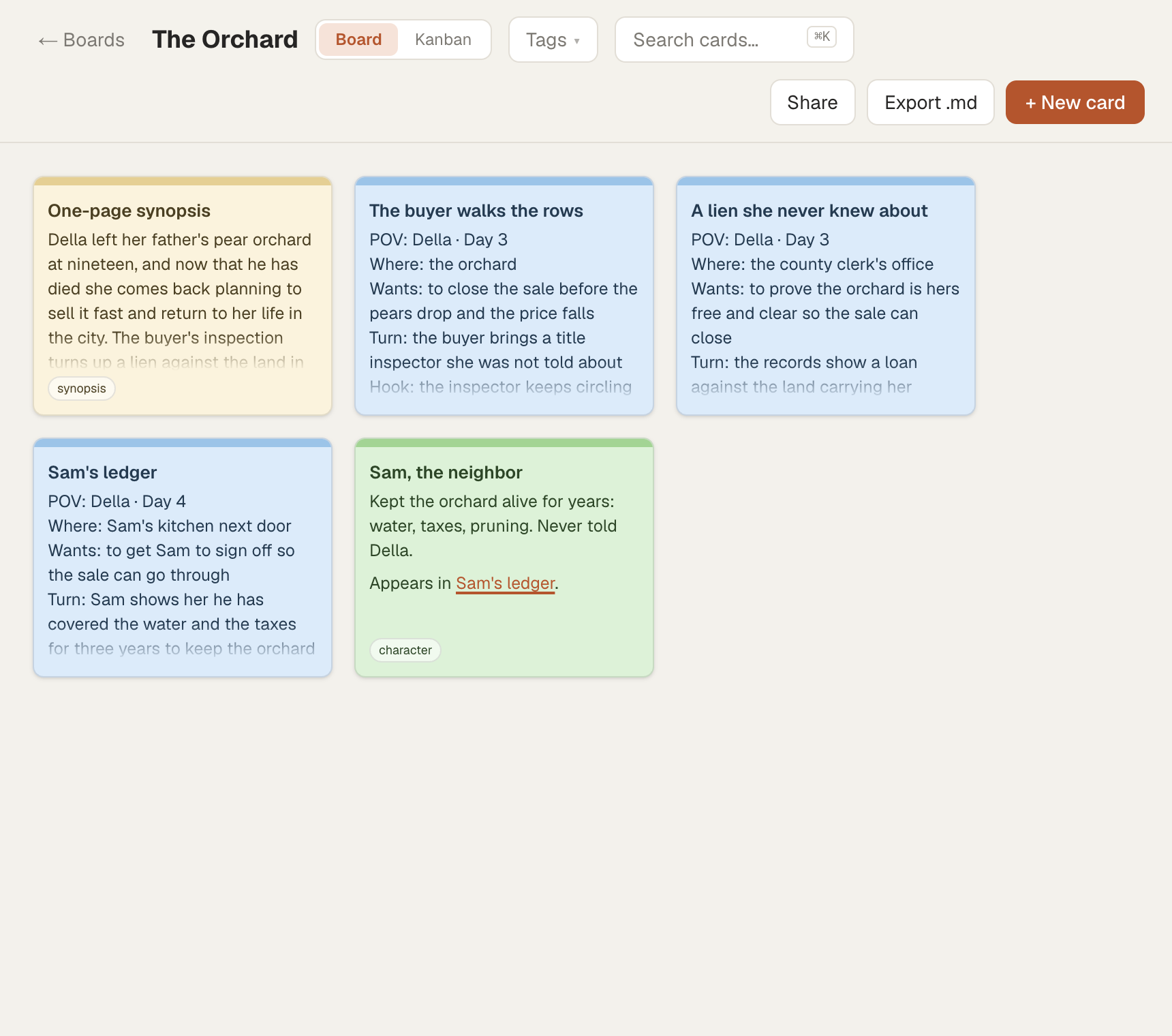
Cork is a fantastic place to organize a story using the snowflake method. Start with a set of ordinary cards, and use links and tags to manage the bookkeeping the method would otherwise leave you to do in your head.
Try it
You can run the whole snowflake method on paper and a pack of index cards, and plenty of writers do. Start with the one sentence, grow it in passes, and stop planning the moment a scene starts pulling at you.
If you would rather keep the passes in one searchable place, link your characters to their scenes, and reorder the deck without rewriting a card, Cork is free to try: three boards on the free plan, and paid from $19 a year if you outgrow it.