Three-act structure template
A Cork board with the six turning points of a three-act story in four Kanban columns, with the middle act split at the midpoint.
See also: How to outline a novel with the 3-act structure
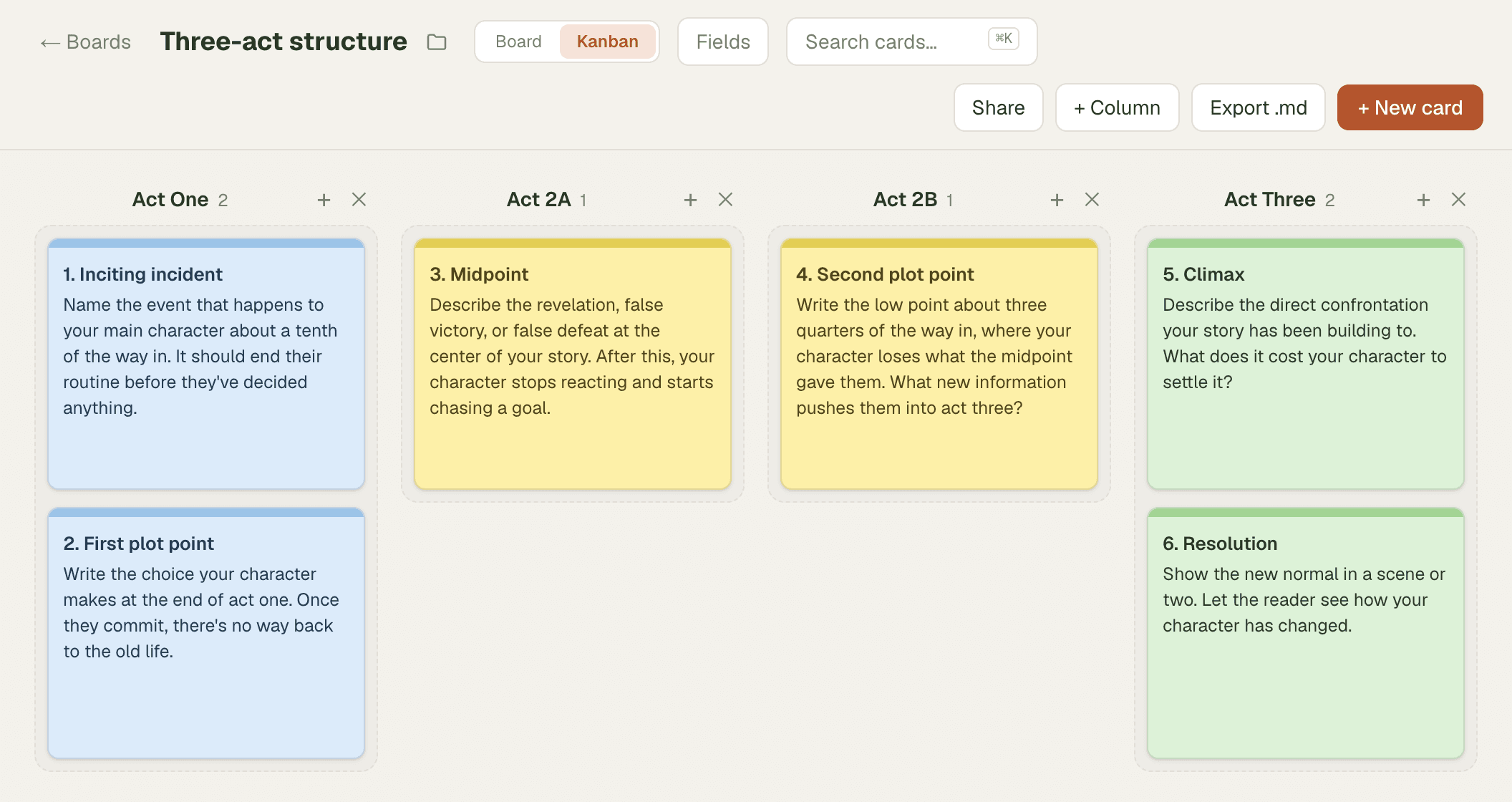
The three-act structure divides a story by the job each part does. Act one sets up a character and breaks something in their world, act two puts them through escalating trouble, and act three forces the confrontation that settles the story's main question. Six turning points mark the shape: the inciting incident, the first plot point, the midpoint, the second plot point, the climax, and the resolution.
The idea of a beginning, middle, and end goes back at least to Aristotle, and the modern version comes from screenwriter Syd Field's 1979 book Screenplay: The Foundations of Screenwriting. It fits most novels and scripts, and it gives you a frame to check a draft against when something feels off.
How to use this template
- Start a board from the template. You get six turning-point cards in four Kanban columns: Act One, Act 2A, Act 2B, and Act Three. Act two usually runs longer than the other two acts combined, so splitting it at the midpoint gives the long middle two halves you can plan one at a time.
- Open each card, read the prompt, and replace it with what happens at that turn in your story.
- If you already know your ending, start with the climax and work back to the inciting incident, checking that each turn is caused by the one before it.
- Add scene cards between the turning points as you plan. A column with few cards shows you where the story needs more.
Read the full guide: How to outline a novel with the 3-act structure