How to outline a novel with the 3-act structure
What the three-act structure is, the six beats that mark its turns, why act two often sags, and how to lay the whole shape out as index cards you can move.
The three-act structure divides a story into three parts by the job each part does. Act one introduces a character and describes the world they live in. Then it breaks something about that world. Act two puts the character through escalating trouble and takes away the easy ways out. Act three forces the confrontation that settles the main question being asked in the story. The proportions are roughly a quarter, a half, and a quarter, which means act two runs as long as the other two acts combined. Six core beats mark the turns between and inside the acts: the inciting incident, the first plot point, the midpoint, the second plot point, the climax, and the resolution.
This guide covers where the structure came from, what each act and beat is for, why the middle collapses so often, and how to lay it out as index cards you can rearrange.
Where does the three-act structure come from?
The oldest version of the idea is in Aristotle's Poetics, written around 335 BC. In Part VII he gives the definition that lays the foundation for this structure: "A whole is that which has a beginning, a middle, and an end." While he isn't describing acts, he is arguing that a plot has to contain a complete action of a certain magnitude, arranged so that events follow each other by necessity rather than accident. That causality requirement is what still separates a structured story from just a sequence of things that happen.
In 1863 the German novelist Gustav Freytag published Technique of the Drama, which broke the classical play into five parts and drew them as a pyramid: introduction, rise, climax, return, catastrophe. He was analyzing Greek and Shakespearean tragedy, and his diagram is why people still frequently picture story structure as a triangle with a peak in the middle.
The modern version comes from screenwriter Syd Field, whose 1979 book Screenplay: The Foundations of Screenwriting named the three acts setup, confrontation, and resolution, and pinned them to page counts. In a 120-page script, act one runs to about page 30, act two to about page 90, and act three to the end, with a plot point turning the story at each act break. Field called this the Paradigm, and he published a worksheet for filling it out. Hollywood adopted it, novelists borrowed it from Hollywood, and nearly every structure system sold since is a variation on those proportions.
Read Field for where the turns go and Aristotle for why they count: a turn only works if it was caused by what came before.
What are the three acts?
Here is a working definition of each act, by the job it does:
Act one establishes a character with a want and a life, then introduces the problem that makes that life impossible to continue.
Act two pits the character against escalating opposition and closes off every easy solution.
Act three puts the character in direct conflict with the problem and settles it, then shows what the world looks like afterward.
The proportions matter as much as the jobs. Act one is about a quarter of the book, act two about half, act three about a quarter. In a 90,000-word novel, that is roughly 22,000 words of setup, 45,000 words of middle, and 22,000 words of ending. Treat those numbers as a starting shape. A thriller often runs a shorter act one because the reader wants the trouble sooner, and a family saga a longer one, because the relationships have to be established before they can break.
The proportions are mainly a diagnostic. If act one holds 40 percent of your scenes, the setup is eating the book. If act three holds five scenes and act two holds 40, the ending will feel rushed no matter how well you write it.
What are the six beats?
Six turns accomplish most of the structural work. Here they are in order, with where they usually land.
- The inciting incident, around a tenth of the way in. The event that breaks the routine. It happens to the character rather than being chosen by them, and it makes the old life impossible to keep. It has not yet led to a decision.
- The first plot point, at the end of act one, around a quarter of the way in. The character decides, commits, and crosses into the new situation. The door closes behind them. Everything after this is a consequence of a choice they made, which is what keeps the middle from feeling imposed.
- The midpoint, at the center. Something reframes the story: a revelation, a false victory, a false defeat. The job of the midpoint is to flip the character from reactive to active. Before now they are responding to a problem, and after they are pursuing a goal.
- The second plot point, around three quarters of the way in. Often called the dark moment or the low point. The character loses the thing the midpoint gave them, and usually something else besides. This beat produces the final piece of information that drives act three forward.
- The climax, near the end. The character confronts the problem directly, using what they learned, and pays for it. This is the scene the whole story has been building toward.
- The resolution, the last few percent of the book. It shows the new normal, demonstrating the change rather than explaining it to keep things tight.
The beats are questions before they are anything else. If you cannot name your midpoint, your book probably does not have one yet, and that is worth knowing at the outline stage instead of 45,000 words into drafting.
Why does act two sag, and what fixes it?
Act one has a clear finish line (the problem). Act three is short and keeps momentum by building to the climax and denouement, where everything is tidied up. But act two asks you to sustain half the book on nothing but escalation, and escalation is hard to keep inventing.
Sagging middles usually have one of four causes.
The protagonist is reactive for too long. They respond to whatever the plot throws at them and never form a plan of their own. Fix this at the midpoint by giving them a goal they choose.
The scenes are episodic. Each one works, and none of them causes the next. Test it with Aristotle's standard: can you connect your scenes with "therefore" and "but," or only with "and then"? If it is "and then," the chain is broken.
There is no clock. Nothing forces the pace. A deadline, a countdown, a rival closing in, or a resource running out will do more for a middle than any amount of new action.
The stakes stop rising. The character risks the same thing in chapter 12 that they risked in chapter six. Take away something they were counting on, then take away the fallback.
The practical move for outlining is to split act two in half and treat the two halves as separate units, with the midpoint as the boundary. Act 2A is the reactive half. Act 2B is the active half, running from the midpoint down into the second plot point. Two stretches of approximately 22,000 words with different jobs are far easier to fill than one undifferentiated 45,000-word block.
How do you lay the three acts out on a corkboard?
Start with one card per beat. Six cards is enough to hold the shape of an entire novel.
Create a board and pick a view. Here are two arrangements that work well.
Kanban columns, one per act. Name four columns Act One, Act 2A, Act 2B, and Act Three, splitting the middle at the midpoint for the reason above. Drop each beat card into its column. Once you expand into scenes, the column heights show your proportions directly: if Act One is taller than Act 2A and Act 2B together, you have found your problem without counting anything.
Corkboard rows, one per act. The free-form corkboard view has snap-to-grid placement, so you can lay three rows of cards that read left to right. This suits the early stage, when you are moving beats around to see where they want to sit, and it lets you stack scene cards under the beat they serve.
Use card colors to group cards in each act, so you can read the structure at a glance and catch a card sitting in the wrong run.
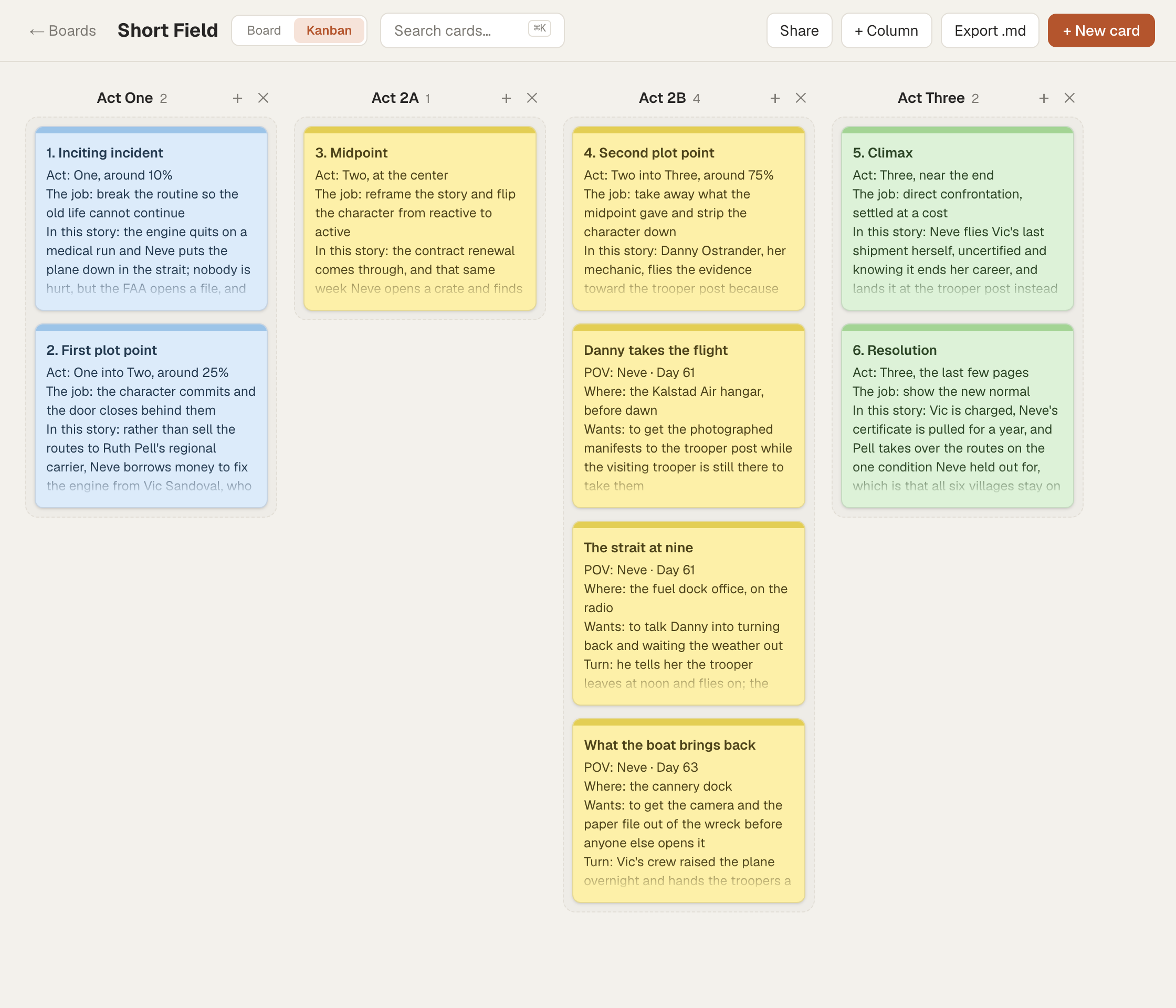
Then expand. Each beat card becomes a small pile of scene cards using the five fields from our guide to scene cards: a title, the point-of-view character and time, the want, the turn, and the hook. Stack them under the beat card, or give scenes their own board and wiki-link each one back to the beat it serves, so opening the midpoint card shows every scene pointing at it. Tags let you mark beats with one tag and scenes with another, then filter down to the six beats when you want the aerial view again.
Cork is for planning, so the draft happens somewhere else. When the outline is ready, export the board to markdown and take it to whatever you write in.
An example: Short Field
Here is one story carried through all six beats, so you can see the causal chain.
Premise: Neve Kalstad flies mail, groceries, and medical runs to six villages out of Halstead Bay in two float planes she inherited from her father. She is two months behind on payments for the older plane. Alma Nakoa, the health aide who serves those villages, rides with her most weeks.
Six beat cards, one per turn:
1. Inciting incident
Act: One, around 10%
The job: break the routine so the old life cannot continue
In this story: the engine quits on a medical run and Neve puts the plane down in the strait; nobody is hurt, but the FAA opens a file, and her insurer freezes coverage until it closes
2. First plot point
Act: One into Two, around 25%
The job: the character commits and the door closes behind them
In this story: rather than sell the routes to Ruth Pell's regional carrier, Neve borrows money to fix the engine from Vic Sandoval, who runs the fuel dock and the cannery freight, on the condition that she flies his crates on demand and does not weigh them
3. Midpoint
Act: Two, at the center
The job: reframe the story and flip the character from reactive to active
In this story: the contract renewal comes through, and that same week Neve opens a crate and finds diverted prescription drugs bound for the clinics Alma runs; she starts photographing Vic's manifests
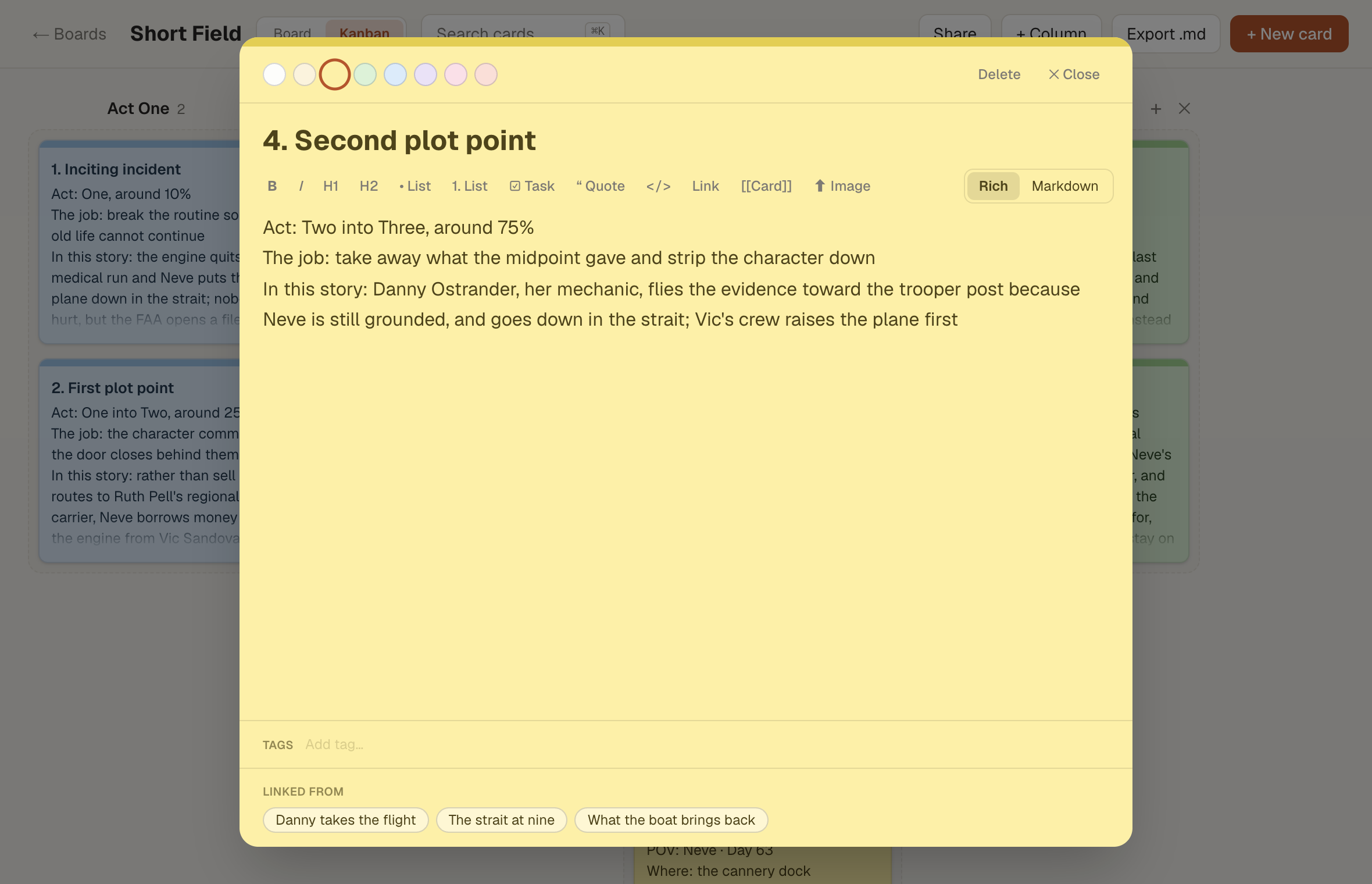
4. Second plot point
Act: Two into Three, around 75%
The job: take away what the midpoint gave and strip the character down
In this story: Danny Ostrander, her mechanic, flies the evidence toward the trooper post because Neve is still grounded, and goes down in the strait; Vic's crew raises the plane first
5. Climax
Act: Three, near the end
The job: direct confrontation, settled at a cost
In this story: Neve flies Vic's last shipment herself, uncertified and knowing it ends her career, and lands it at the trooper post instead of the village
6. Resolution
Act: Three, the last few pages
The job: show the new normal
In this story: Vic is charged, Neve's certificate is pulled for a year, and Pell takes over the routes on the one condition Neve held out for, which is that all six villages stay on the schedule
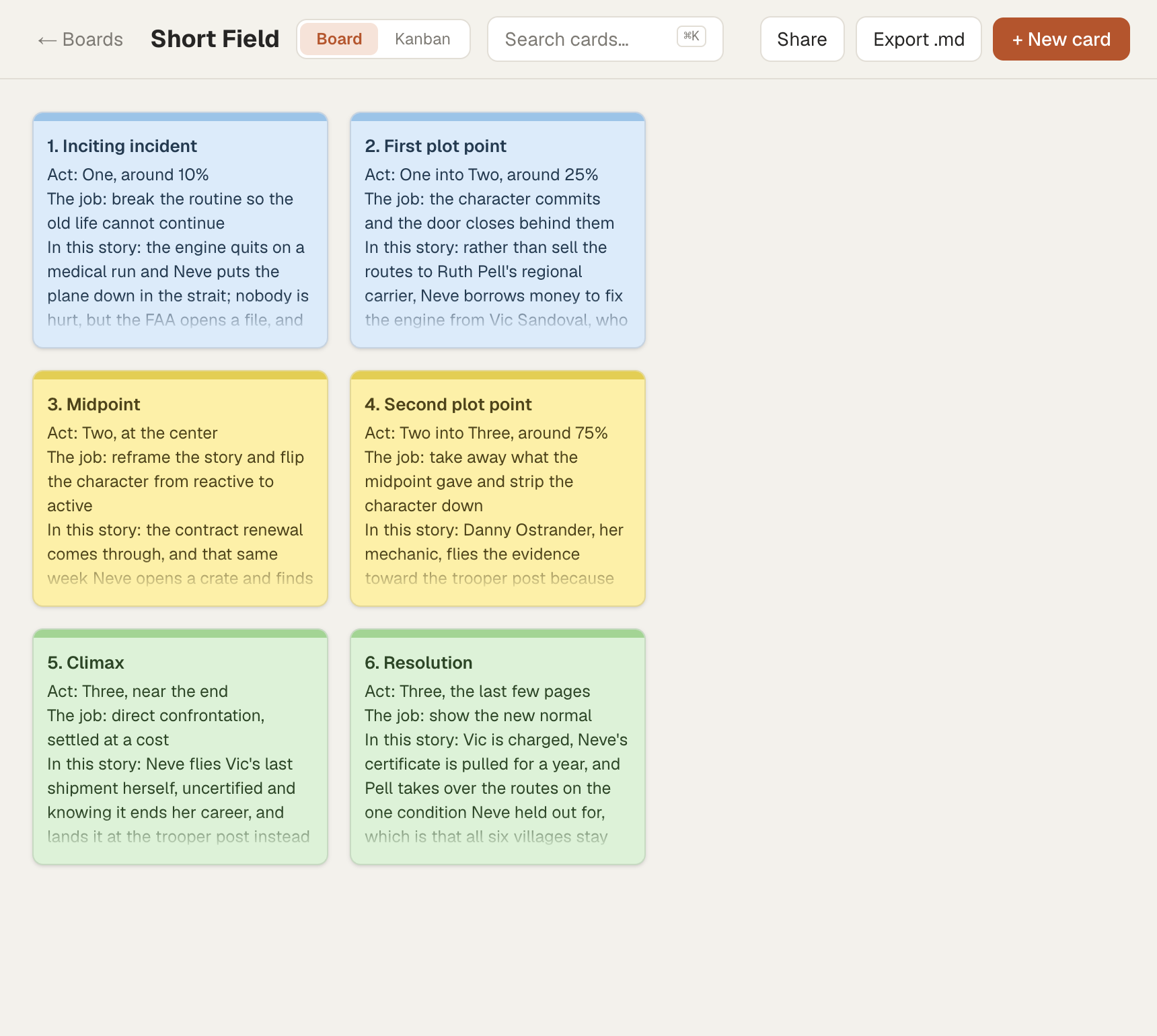
Now take one beat and open it into scenes. The second plot point is three scenes, and Neve's want holds them together: she wants her photographs of Vic's manifests in a trooper's hands before he works out that she has seen inside a crate.
Danny takes the flight
POV: Neve · Day 61
Where: the Kalstad Air hangar, before dawn
Wants: to get the photographed manifests to the trooper post while the visiting trooper is still there to take them
Turn: Danny reminds her she cannot legally fly until the FAA closes the ditching file, and takes the keys himself
Hook: the front she has been watching all week is due over the strait by nine
The strait at nine
POV: Neve · Day 61
Where: the fuel dock office, on the radio
Wants: to talk Danny into turning back and waiting the weather out
Turn: he tells her the trooper leaves at noon and flies on; the radio goes quiet twenty minutes later
Hook: Vic is standing in the doorway behind her, and he has been there long enough
What the boat brings back
POV: Neve · Day 63
Where: the cannery dock
Wants: to get the camera and the paper file out of the wreck before anyone else opens it
Turn: Vic's crew raised the plane overnight and hands the troopers a clean, empty airframe
Hook: the trooper asks Neve why her mechanic was flying a route she signed for
Follow the chain. The grounding from beat one is why Danny is in the seat. The deadline is why he flies into bad weather. The wreck is why the evidence is gone and why suspicion lands on Neve. Each turn produces the next scene's problem, and the last hook is what act three has to solve.
Where does the three-act structure stop helping?
Field wrote the Paradigm for a two-hour film with one protagonist and one arc, enforced by running time. Novels have room for several points of view, multiple subplots, and long interior stretches with no external event, so the beats stretch unevenly and sometimes appear more than once across different threads.
Some books resist it outright. Nonlinear novels, ensemble casts, and books built on voice can be forced into three acts, but the forcing tends to show. A beat you cannot fill is information: check whether it's the story that is broken or the organizational model.
If six beats feel too sparse, the Save the Cat beat board is the same three acts subdivided into 15 beats, with Blake Snyder's five-beat act one and seven-beat act two doing at a finer grain exactly what the six beats do here. If you would rather grow the structure out of your own material instead of fitting material into a frame, the snowflake method starts from one sentence and expands. All three end in a stack of scene cards on a board.
Try it
Write the six beat names on six index cards and fill in what your story does at each one. The beats you stall on are the ones worth thinking about first.
If you want a board you can rearrange, color by act, and link to your scene cards, Cork is free to try: three boards on the free plan, no credit card.