
The Save the Cat beat sheet: how to build a beat board with index cards
What the Save the Cat beat sheet is, all 15 beats explained, and how to turn them into a movable beat board of index cards for your novel.
The Save the Cat beat sheet is a 15-beat map of a story, created by screenwriter Blake Snyder in his 2005 book Save the Cat! The Last Book on Screenwriting You'll Ever Need. Each beat names a specific job the story does at a specific point, from the Opening Image that shows the world before anything changes to the Final Image that shows what it became, with the big turns landing at predictable places in between. Writers use it as a structural checklist: 15 questions your story has to answer, in order. Novelists have their own version in Jessica Brody's Save the Cat! Writes a Novel (2018), which retunes the same 15 beats for printed books.
Those 15 beats are 15 index cards waiting to happen. This guide covers what defines each beat and how to lay the beats out on a cork board you can move, with each beat card holding the scenes that fill it.
Where does the Save the Cat method come from?
Snyder wrote his method for other screenwriters, but it spread past Hollywood fast, because the beat sheet turned out to be an easily comprehensible structure for how a lot of stories are built. Though Snyder died in 2009, the method has been carried on since by his collaborators at savethecat.com. The title comes from his advice about likability: early on, give your hero a moment where they do something decent for someone else, the way a character might stop to rescue a cat from a tree. Readers decide quickly whether to root for someone, and one act of generosity buys a lot of patience later.
For novelists, Brody's Save the Cat! Writes a Novel takes Snyder's 110-page screenplay format, where every beat has a page number, and reframes it for novels, which unfold differently. Brody keeps the 15 beats, works out what they mean across 60 or 80 scenes, and sorts novels into genre categories with their own expectations. This guide names the beats so you can build a board today, and both books are worth reading for the case studies that make each beat click.
What are the 15 beats?
Here are all 15, grouped into the three acts they fall into.
Act One covers roughly the first fifth of the book.
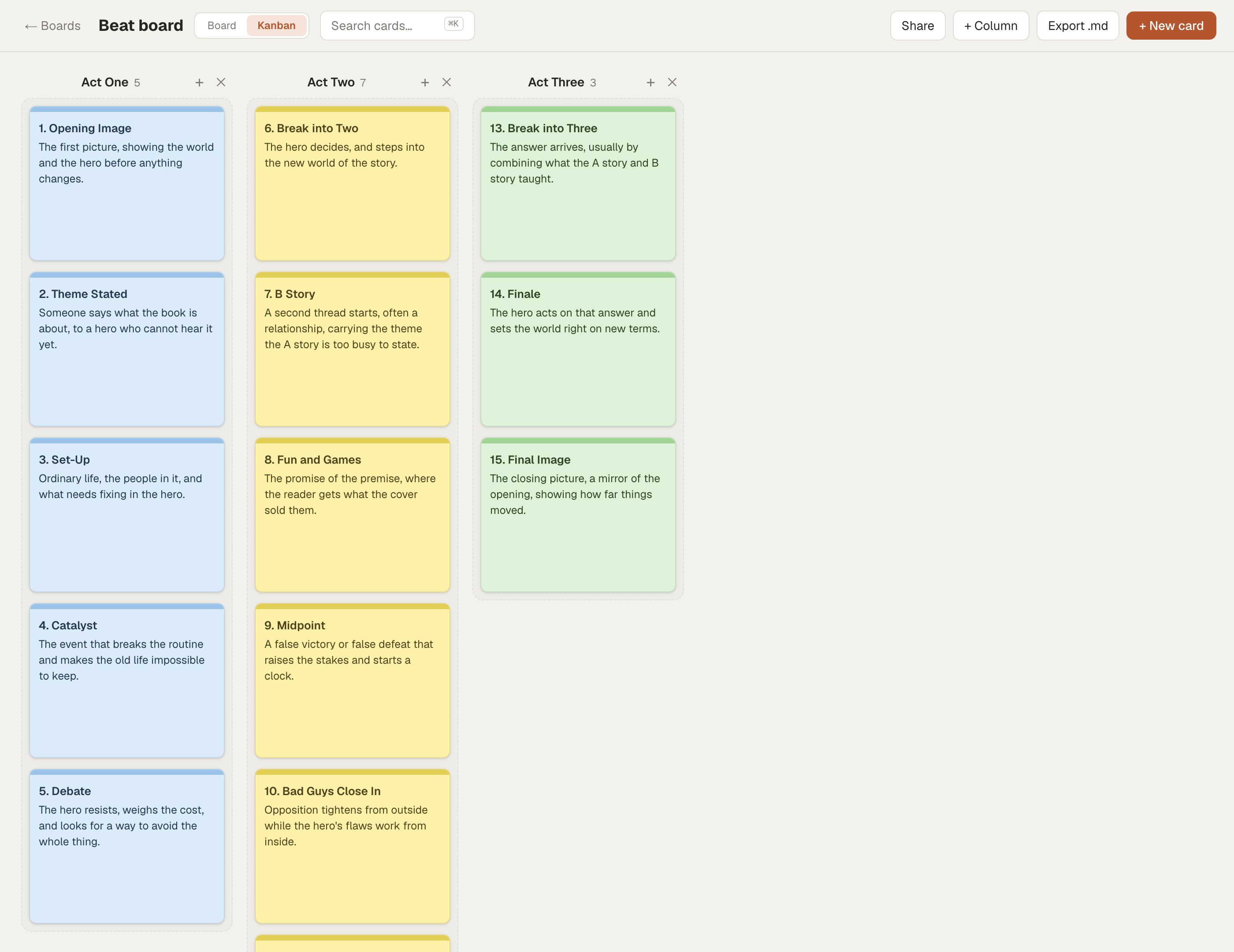
- Opening Image. The first picture, showing the world and the hero before anything changes.
- Theme Stated. Someone says what the book is about, to a hero who cannot hear it yet.
- Set-Up. Ordinary life, the people in it, and what needs fixing in the hero.
- Catalyst. The event that breaks the routine and makes the old life impossible to keep.
- Debate. The hero resists, weighs the cost, and looks for a way to avoid the whole thing.
Act Two covers roughly the middle half.
- Break into Two. The hero decides, and steps into the new world of the story.
- B Story. A second thread starts, often a relationship, carrying the theme the A story is too busy to state.
- Fun and Games. The promise of the premise, where the reader gets what the cover sold them.
- Midpoint. A false victory or false defeat that raises the stakes and starts a clock.
- Bad Guys Close In. Opposition tightens from outside while the hero's flaws work from inside.
- All Is Lost. The low point, where the midpoint win gets taken away. Snyder paired this beat with a "whiff of death," something ending for good.
- Dark Night of the Soul. The hero sits inside the loss long enough to run out of old answers.
Act Three covers roughly the last quarter.
- Break into Three. The answer arrives, usually by combining what the A story and B story taught.
- Finale. The hero acts on that answer and sets the world right on new terms.
- Final Image. The closing picture, a mirror of the opening, showing how far things moved.
Read the list top to bottom and you'll be able to identify where your own book is thin. Many drafts have a strong Catalyst and a vague Midpoint. The beats are diagnostic questions that pay off when you answer all 15.
What do you gain by putting the beats on cards?
A beat sheet is usually presented as a numbered list, which is fine for reading and awkward for working. Here is what changes when each beat gets its own card.
You can move them. Beats shift as you plan. Your Catalyst turns out to be the better Break into Two, and your Midpoint reveal wants to happen earlier. On a list that means retyping — and retyping again if it doesn't work out — and on a board it is a two-second drag.
You can see the proportions. All 15 beats look the same size in a list, and they are wildly different sizes in a book. Fun and Games often runs a quarter of the whole novel, while Theme Stated is one line of dialogue. Once each beat card holds the scenes that fill it, a Fun and Games section with two scenes under it is a visible problem.
A beat card becomes a container. A beat is a job the story does, and a scene is how it gets done. One beat card can sit above two, three, or 15 scene cards, so the board holds both levels at once.
Empty beats stay visible. A blank card labeled Dark Night of the Soul is a standing question you cannot scroll past. Using a cork board keeps your structure and your scenes in the same field of view, where each can correct the other.
How do you build a beat board in Cork?
Cork has no Save the Cat template, so you'll manually add the 15 cards once. Start with a new board and pick a view. Here are two arrangements that work well.
Use kanban columns, one per act. Name three columns Act One, Act Two, and Act Three, then drop the beat cards in order: five cards, then seven, then three. The column heights show the shape immediately, with Act Two running roughly twice as long as either neighbor. Dragging a card between columns is how you test whether a beat lands too early. Once you're ready for scenes, you can add cards for those scenes and stack them below each beat, or create a new board and link each scene back to the associated beat.
Alternatively, you could create 15 columns, one for each beat. Place a card at the top with the main action for each beat and then lay scene cards out vertically in each column.
Or use corkboard rows, one per act. The free-form corkboard view gives you snap-to-grid placement, so three rows of beat cards read left to right like a timeline. It also lets you stack scene cards underneath the beat card they belong to.
Use card colors to carry one extra signal. Coloring by act is simplest, and coloring the A story one way and the B story another gets useful once scenes go in, because then you can see whether the B thread disappears for a hundred pages.
Two more Cork features that work well here. Tags let you mark beat cards with one tag and scene cards with another, then filter down to the 15 beats for the aerial view. Wiki-links connect a scene card to the beat it serves and the characters in it, and each card collects backlinks, so opening the All Is Lost card shows every scene pointing at it.
From one beat card to scene cards
A beat card tells you the job. Scene cards tell you how it gets done, using the five fields from our scene cards guide: a title, the point-of-view character and time, the want, the turn, and the hook. Here is an example from a romantic comedy, called Off Menu.
Premise: Priya Raman has cooked someone else's menu for six years. When a neighborhood restaurant closes, she talks the landlord Hollis into offering her a one-month pop-up in its kitchen, hoping an investor named Marguerite will fund a place of her own. On opening day she finds Dez Okonkwo already unloading pastry molds: Hollis double-booked the month, Dez holds a signed agreement of his own, and only one of them can take the permanent lease when the pop-up ends.
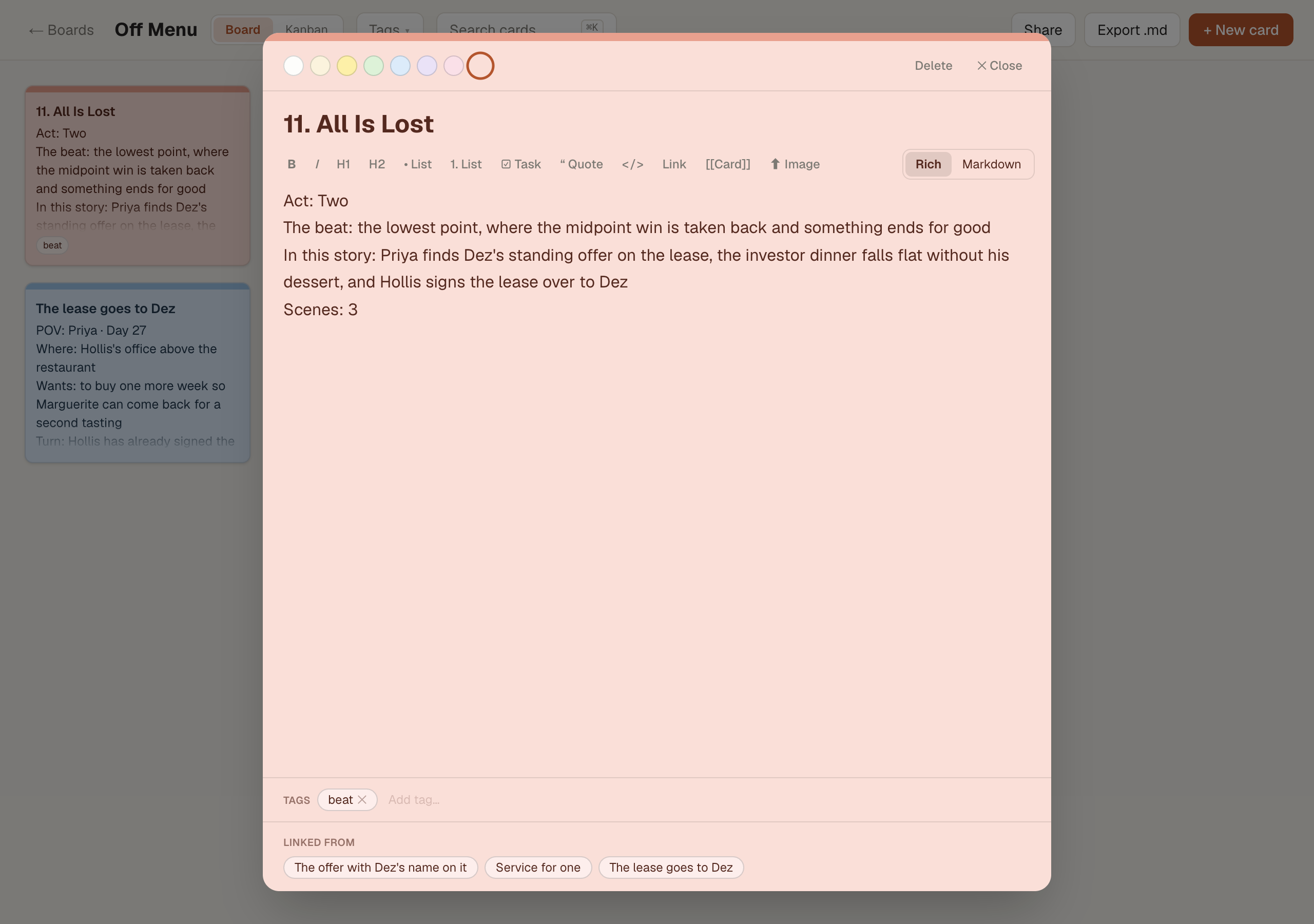
Let's take a look at beat 11, All Is Lost, which is meant to take back whatever the Midpoint gave. At the Midpoint, Priya and Dez combined their menus into a tasting that sold out for a week, and his dessert was the course everyone talked about. They agree to go after the funding together. Here is the beat card:
11. All Is Lost
Act: Two
The beat: the lowest point, where the midpoint win is taken back and something ends for good
In this story: Priya finds Dez's standing offer on the lease, the investor dinner falls flat without his dessert, and Hollis signs the lease over to Dez
Scenes: 3
Now the three scenes that carry it. Priya's want holds the sequence together: she wants the money for her own restaurant, and she wants it on her own terms.
The offer with Dez's name on it
POV: Priya · Night 26
Where: the restaurant office, an hour before service
Wants: to confirm the joint lease application she and Dez agreed to file
Turn: the file holds Dez's solo offer, dated three weeks before they teamed up and never withdrawn
Hook: Marguerite arrives in an hour and Priya has to cook the most important meal of her life beside Dez, knowing about this betrayal
Service for one
POV: Priya · Night 26
Where: the pass, during the investor tasting
Wants: to win Marguerite's funding without letting anything show
Turn: she cuts Dez's dessert from the menu, and the meal ends on nothing
Hook: Marguerite thanks her warmly, says the food is very good, and does not mention money again
The lease goes to Dez
POV: Priya · Day 27
Where: Hollis's office above the restaurant
Wants: to buy one more week so Marguerite can come back for a second tasting
Turn: Hollis has already signed the permanent lease with Dez, whose solo offer sat on his desk the whole month
Hook: the kitchen she cooked in last night now belongs to the man who hid the offer from her
Follow the causal chain. Priya wants funding on her own terms, so Dez's hidden offer makes his dessert unusable to her, so the tasting ends flat, so Marguerite passes, so Hollis takes the certain offer over the promised one. Each turn produces the next scene's problem, and the last hook drops her into beat 12 with no investor, no kitchen, and no partner she can trust.
Build the rest of the book this way, one beat at a time. Theme Stated might need a single scene, and Fun and Games might hold 12. A beat is a question, a scene is an answer, and both belong on the same board.
Where does the beat sheet stop helping?
The method is a scaffold, and scaffolds come with limits worth knowing before you start. Snyder built the beat sheet for films, where a 110-page script has one protagonist, one clean arc, and a running time that enforces the proportions. A novel has room for four subplots, three points of view, and long interior stretches with no external event at all, so the beats stretch unevenly. That is the gap Brody's adaptation was written to close.
Some books also resist the mold. Ensemble novels, thoughtful literary fiction, nonlinear structures, and books built on voice can all be forced into 15 beats, and the forcing usually shows on the page. Treat a beat you cannot fill as information about your book.
Planning tools differ in where the structure comes from. The snowflake method grows a story outward from one sentence, so the shape emerges from your own material, while Save the Cat hands you a 15-slot frame up front. Both end in a stack of scene cards you can lay out and read. For the craft of arranging those scenes into acts, see our guide to outlining a novel with index cards.
The 15 beats will tell you a great deal about your draft, and the beats that are hard to fill are worth sitting with before you decide they are wrong.
Try it
Write the 15 beat names on index cards, lay them out in three rows, and fill in what your story does at each one.
If you want a board you can easily rearrange, filter, and link to your scene cards, Cork is free to try: three boards on the free plan, and paid from $19 a year if you outgrow it.