How to make a character bible with index cards
What a character bible is, what goes on a character card field by field, and how linking cards to scenes turns the bible into a live index of appearances.
A character bible is the reference a writer keeps on the people in their story, with one entry per character holding the details you have to keep straight across a long draft. A typical entry covers who the character is, their motivations, how they talk, the physical details you might mix up, their relationships with other characters, and what they are hiding. Writers keep one so that on page 400 the sister still has gray eyes, the innkeeper still resents the same man for the same reason, and everybody still sounds like themselves. Your character bible could live in a document, but index cards in Cork are especially well-suited, because a card can link to the scenes its character appears in.
This guide covers what goes on a character card, how much a minor character needs, and how linking those cards to your scenes turns a static dossier into a live index of your cast. If you have not built scene cards yet, start with our guide to what goes on a scene card.
Why keep a character bible?
The first reason is continuity. A novel often takes months or longer to write, and your memory of a minor character decays faster than the draft grows. Eye colors drift, ages stop adding up, a dead father is mentioned twice with two different jobs. These details become even more difficult to track as your story goes through major revisions.
The second reason is voice. Characters go flat when they all sound like the author, so keeping notes about how a character talks will make them feel more alive and authentic.
The third reason is history. Your character bible tracks the grudges, debts, and old kindnesses a reader will notice if they're dropped. If you have run the snowflake method, Randy Ingermanson's character passes produce exactly this material, and the bible is where you keep it so it stays consistent.
Why a set of cards beats a document
A document holds your cast in one fixed order, and finding anyone means scrolling. A deck holds one character per card, so you can lay all your characters out and see everyone at once, color the cards by faction or family, or filter down to a single household.
If you use a software tool like Cork, you can also add tags and links between cards using [[double brackets]] to give your cards more context within your larger story outline (more on that below).
What goes on a character card?
Cards should hold any information about your characters that will aid you in writing about them or from their point of view. It's best to keep exposition to a minimum on these cards. You want this to be something you can visit frequently and easily as you write, not something you have to dig through pages of minutiae to find the few details you need.
Below are six items you can put on a character card. Don't treat this as gospel, though. Track what makes sense for you to track. If tracking important items that your characters are carrying with them is important to your story, include that on your cards, even though it's not mentioned below.
1. Role
Who this person is in this story, in a single phrase. "The dye-works merchant who paid for the key" tells you why the character exists. "A complicated man with a difficult past" gives you nothing to work with.
2. Wants and needs
The want is what they are chasing in the plot. The need is what the story is really about for them, though they may not know it. The want drives the action, and the need decides what the ending costs them.
3. Voice and manner
Details about how they speak and carry themselves: sentence length, what they do with a hard question, the tic that shows up when they are cornered.
4. Physical details
Write down anything you need to keep consistent: age, height, facial features, favorite foods, etc. This is also the place to store reference pictures.
5. Relationships
Who this character is connected to and how. Write each one with a direction: hired, owes, raised, betrayed. Directional ties let you check a cast for balance, because a character nobody is tied to is usually a character you can cut.
6. Anti-characteristics
These are things that you would describe as "out of character." Anything that would break the realism of a character if they did it or said it.
How much does a minor character need?
While it often depends on the depth of your world-building, usually far less than you think. A minor character card can be two lines: role and ties. The toll collector who appears once needs a name, a job, and a note about who pays him. Expand too much and you might find yourself writing a novel about a toll collector. But if the toll collector appears again and has a distinctive scar that will be noticed each time, put it on the card.
Your character cards need not all look the same. A protagonist card can run long enough to scroll and a walk-on card can be a name and a sentence, as long as everyone in the book has a card somewhere.
An example: a cast from a fantasy quest
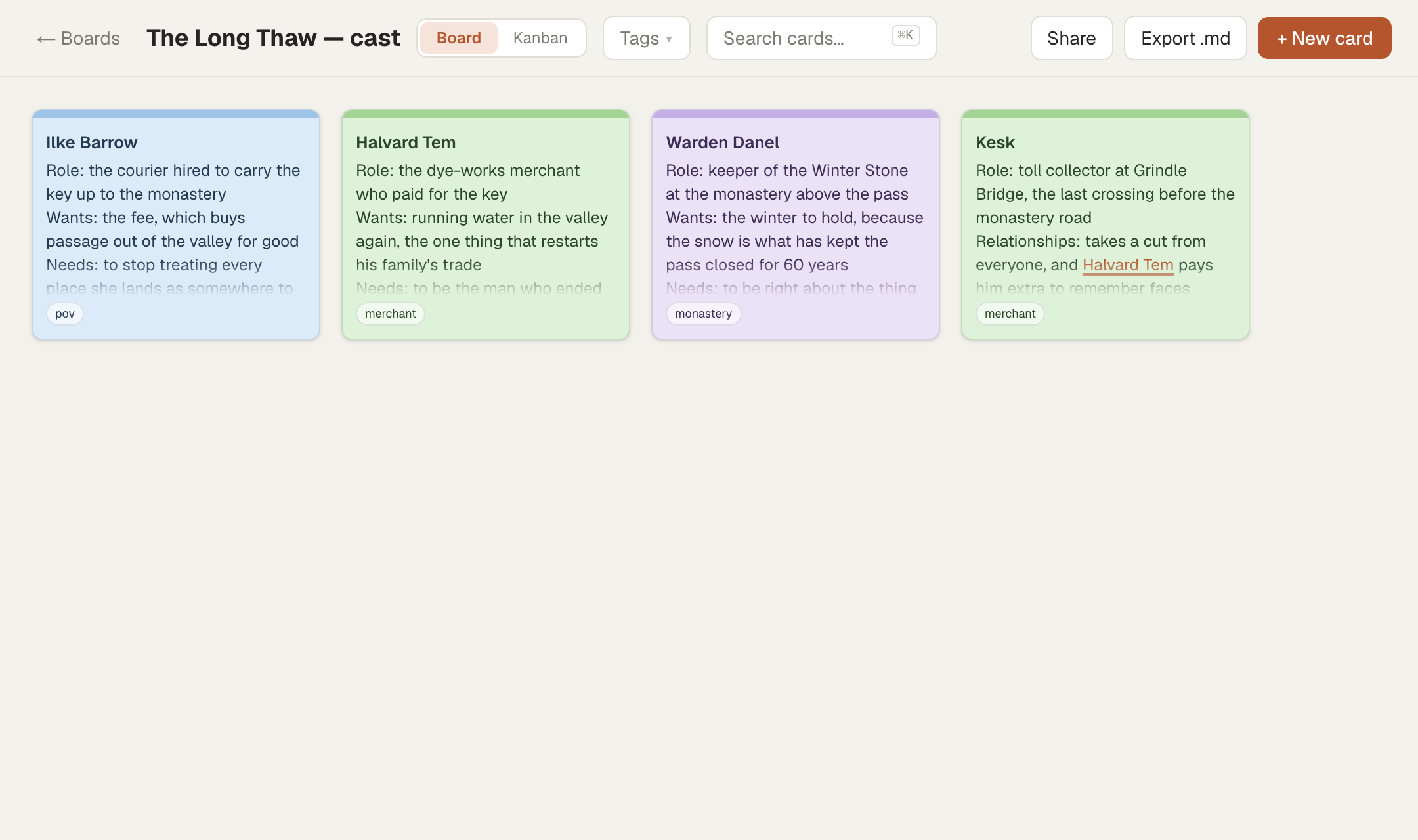
Here are four cards from a fantasy story called The Long Thaw.
Premise: Sixty years ago the valley of Ostvale used magic to plunge itself into permanent winter and close the mountain pass against its enemies, anchoring the spell to a relic called the Winter Stone in a monastery above the pass. Ilke Barrow, a courier, is hired to carry a stolen key up the monastery road so the stone can be broken and the valley can thaw. Her client keeps one thing to himself: 60 years of packed snow will come down all at once, onto the flat ground where Ilke's village sits.
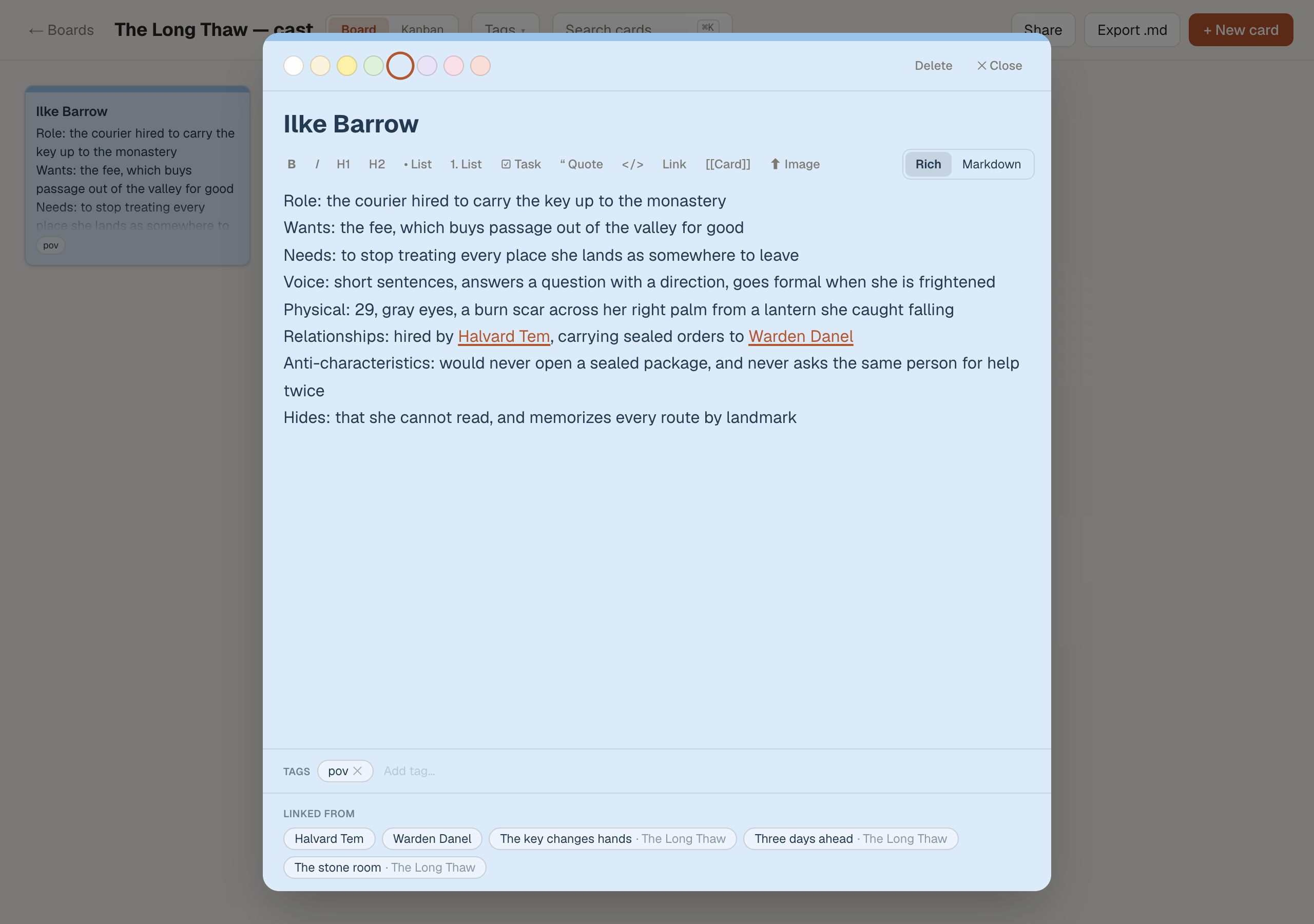
Ilke Barrow
Role: the courier hired to carry the key up to the monastery
Wants: the fee, which buys passage out of the valley for good
Needs: to stop treating every place she lands as somewhere to leave
Voice: short sentences, answers a question with a direction, goes formal when she is frightened
Physical: 29, gray eyes, a burn scar across her right palm from a lantern she caught falling
Relationships: hired by [[Halvard Tem]], carrying sealed orders to [[Warden Danel]]
Anti-characteristics: would never open a sealed package, and never asks the same person for help twice
Hides: that she cannot read, and memorizes every route by landmark
Halvard Tem
Role: the dye-works merchant who paid for the key
Wants: running water in the valley again, the one thing that restarts his family's trade
Needs: to be the man who ended the winter and to be thanked for it in public
Voice: warm, generous with small favors, asks questions he already knows the answers to
Physical: mid-40s, overdressed for the weather, forever missing one glove
Relationships: hired [[Ilke Barrow]] and wrote the orders she carries; has never met [[Warden Danel]]
Anti-characteristics: never raises his voice, and never makes a threat he would have to carry out himself
Hides: that his surveyors told him the thaw floods the lower villages, and that he bought the high pasture above Nissby last autumn
Warden Danel
Role: keeper of the Winter Stone at the monastery above the pass
Wants: the winter to hold, because the snow is what has kept the pass closed for 60 years
Needs: to be right about the thing he has given his whole life to guarding
Voice: formal, quotes the monastery records by date, never raises his voice
Physical: in his 60s, born into the winter like everyone in the valley, hands wrapped against the cold even indoors
Relationships: expects an inspector from the council; has met neither [[Ilke Barrow]] nor [[Halvard Tem]]
Anti-characteristics: would never leave the monastery unstaffed, and never speculates past what a record can prove
Hides: that the records he quotes stop 20 years short of proving his case
Kesk
Role: toll collector at Grindle Bridge, the last crossing before the monastery road
Relationships: takes a cut from everyone, and [[Halvard Tem]] pays him extra to remember faces
Four cards, and the book already has a shape. Notice the custom "Hides" line on the three major cards, exactly the kind of story-specific addition the six standard items leave room for. Read those lines on their own and you have the plot: a courier who cannot read the orders she carries, a client who knows what the water will do, a warden whose evidence has a hole in it.
What linking does to a bible
Here is a scene card from the same story, using the scene card fields and naming two characters in double brackets:
Three days ahead
POV: [[Ilke Barrow]] · Day 4
Where: the inn above Grindle Bridge
Wants: a bed and a fresh horse before the last climb to the monastery
Turn: [[Halvard Tem]] is sitting by the fire, three days further up the road than he told her he would be
Hook: he chose her route, and she has been following it without reading a word of it
In Cork, a wiki-link like that shows up on the other end. Open Ilke's character card and a "Linked from" row lists every card pointing at her, the ties from other character cards included. The scene entries in that row show her whole run at once: "The key changes hands," "Three days ahead," "The stone room." Open Halvard's card and the same row gathers the two scenes he shares with her plus "The high pasture," his own point-of-view scene. Kesk's two-line card collects the two crossings he appears in.
That row is automatically generated from the links you already wrote, so it stays current without maintenance, and it answers questions a document cannot. Which scenes does Danel appear in, and are they in the last third of the book at all? Has Halvard been out of the story for 15 scenes? Click his card and count.
You can use links even if you're not ready to flesh out a character. A link to a card that does not exist yet renders with a dashed underline as a placeholder, so you can type [[Kesk]] mid-scene and create his card with one click later. And links work across boards, so the bible can be its own board while every scene board points into it.
Should your character bible have its own board?
That's usually wise, especially if you might plan for these characters to live across multiple stories. Give the cast a board of their own, separate from the scene boards, so the bible serves every project that needs it.
When your character bible has its own board, you're also free to use card colors for something structural, like family or timeline or loyalty, so you can more easily sort them at a glance. Add tags for anything you want to filter by: point of view, house or faction, who is alive as of the current draft, etc. You can put reference pictures inside the cards, and utilize search across every board to find precisely what you're looking for.
A character bible template you can copy
Here is the card in a form you can paste onto a blank card:
[Character name]
Role: [who they are in this story, one phrase]
Wants: [what they are chasing in the plot]
Needs: [what the story is really about for them, which they may not know]
Voice: [how they speak and carry themselves]
Physical: [anything you need to keep consistent]
Relationships: [[other character]] and how they are connected
Anti-characteristics: [what would be out of character for them to do or say]
[Anything else your story needs tracked, like a "Hides:" line for secrets]
Try it
Grab a pack of index cards and write out your five most important characters, one per card, using the template above. The blank lines will tell you which people you know and which ones are still hazy.
If you want the bible to index itself, Cork is free to try: three boards on the free plan, wiki-links between every card, and paid from $19 a year if you outgrow it.