How to outline a novel with the Hero's Journey
What the Hero's Journey is, Campbell's 17 stages and Vogler's 12, what to watch out for, and how to lay the whole shape out with index cards.
The Hero's Journey is a story pattern in which a character leaves a familiar world, goes through an ordeal in an unfamiliar one, and comes back changed and carrying something the old world needed. The mythologist Joseph Campbell described it in 1949, after comparing hero myths from many cultures and concluding that they share a universal underlying shape. He called that shape the monomyth and divided it into three movements: departure, initiation, and return, with 17 stages spread across them. Screenwriter Christopher Vogler later reduced those 17 stages to 12 that a working writer can actually use, and Vogler's 12 are what most novelists mean when they say Hero's Journey today.
This guide covers where the pattern came from, what Campbell's 17 stages and Vogler's 12 are for, how the shape lines up with three acts, where the model breaks down, and how to lay out the 12 stages using index cards you can rearrange.
Where does the Hero's Journey come from?
Campbell published The Hero with a Thousand Faces in 1949. He was a professor of comparative literature, and the book sets myths from Greece, Ireland, India, West Africa, and the Americas side by side to argue that they are variations on one story. He borrowed the word monomyth from James Joyce, and built the pattern on Arnold van Gennep's rites of passage and Carl Jung's archetypes, which gave him the mentor, the shadow, and the trickster.
Campbell called separation, initiation, and return "the nuclear unit of the monomyth," and everything else in the book elaborates on those three movements. The Joseph Campbell Foundation keeps an overview of the pattern online.
The book gained a following among storytellers via two routes. First, George Lucas has credited Campbell as a direct influence on Star Wars, and then, in 1985 Christopher Vogler, then a story analyst at Disney, wrote a seven-page memo summarizing the book for other readers in the studio. Photocopies of his memo circulated through Hollywood for years before he expanded it into The Writer's Journey: Mythic Structure for Writers in 1992, dropping the stages that only make sense in myth, renaming the survivors, and cutting the count to 12.
Read Campbell for why the pattern has held so long, and Vogler for how to use it.
What are Campbell's three movements and 17 stages?
The three movements are the part worth memorizing, because they describe a whole story by themselves.
Departure takes the hero out of the ordinary world and across a boundary they cannot casually recross.
Initiation puts the hero through trials in the new world, ending in the central ordeal and whatever it wins them.
Return brings the hero home with what they gained, and tests whether they can live in both worlds.
Now here are Campbell's 17 stages, sorted into those movements.
Departure: the Call to Adventure, Refusal of the Call, Supernatural Aid, the Crossing of the First Threshold, and the Belly of the Whale.
Initiation: the Road of Trials, the Meeting with the Goddess, Woman as the Temptress, Atonement with the Father, Apotheosis, and the Ultimate Boon.
Return: Refusal of the Return, the Magic Flight, Rescue from Without, the Crossing of the Return Threshold, Master of the Two Worlds, and Freedom to Live.
Campbell was describing mythic heroes, and myth does not always map neatly onto a modern novel or screenplay. The Belly of the Whale is Jonah, and Apotheosis is a hero becoming a god. That gap is why Vogler refashioned the list for working writers.
What are the 12 stages most writers use?
Writers tend to gravitate toward the 12-stage journey defined by Christopher Vogler. Here are his stages, grouped by movement, with the job each one does.
Departure
- Ordinary World. The life the hero has before anything changes, shown clearly enough that the reader can measure the loss later. Establish what they want and what they lack.
- Call to Adventure. A problem, an invitation, or a threat that makes the ordinary world impossible to keep.
- Refusal of the Call. The hero hesitates, and the reason tells the reader what the journey will cost.
- Meeting with the Mentor. Someone gives them training, information, or a push. The mentor can be a person, a book, or a memory.
- Crossing the First Threshold. The hero commits and enters the new world. The door closes behind them.
Initiation
- Tests, Allies, Enemies. The rules of the new world are learned the hard way, and the rest of the cast assembles.
- Approach to the Inmost Cave. Preparation for the central confrontation. Plans get made, and the hero's remaining illusions get expensive.
- The Ordeal. The hero faces the thing they most feared, and something in them dies. This is the center of the book.
- Reward (Seizing the Sword). They take something from the ordeal: an object, a truth, a relationship, an ability.
Return
- The Road Back. The hero turns toward home, and the consequences of the ordeal come after them.
- The Resurrection. A final, harder test that proves the change is real rather than temporary.
- Return with the Elixir. The hero comes home with something that heals or changes the world they left.
Start by going through each of these stages and mapping them to your story. You'll see where you need to add more detail or work out holes.
How does this line up with three acts?
The movements map onto acts closely enough to use. Departure is roughly act one, initiation act two, and return act three, so the proportions from our three-act guide apply here too: about a quarter, a half, a quarter.
The turns line up too. Crossing the First Threshold falls at the first plot point, the Resurrection at the climax, and Return with the Elixir at the resolution. The Ordeal is the one that moves. Vogler places it near the center, which makes it the midpoint, though many writers put it three quarters in at the low point, and both work. On a Save the Cat beat board, Break into Two is the first threshold, All Is Lost is the Ordeal placed late, and the Finale is the Resurrection.
Pick one system and stay in it. All three describe the same underlying shape, and switching vocabularies mid-outline will only confuse things.
How do you lay the 12 stages out on a corkboard?
Start with one card per stage, meaning 12 cards for an entire novel.
Start a new board in Cork and then pick a view.
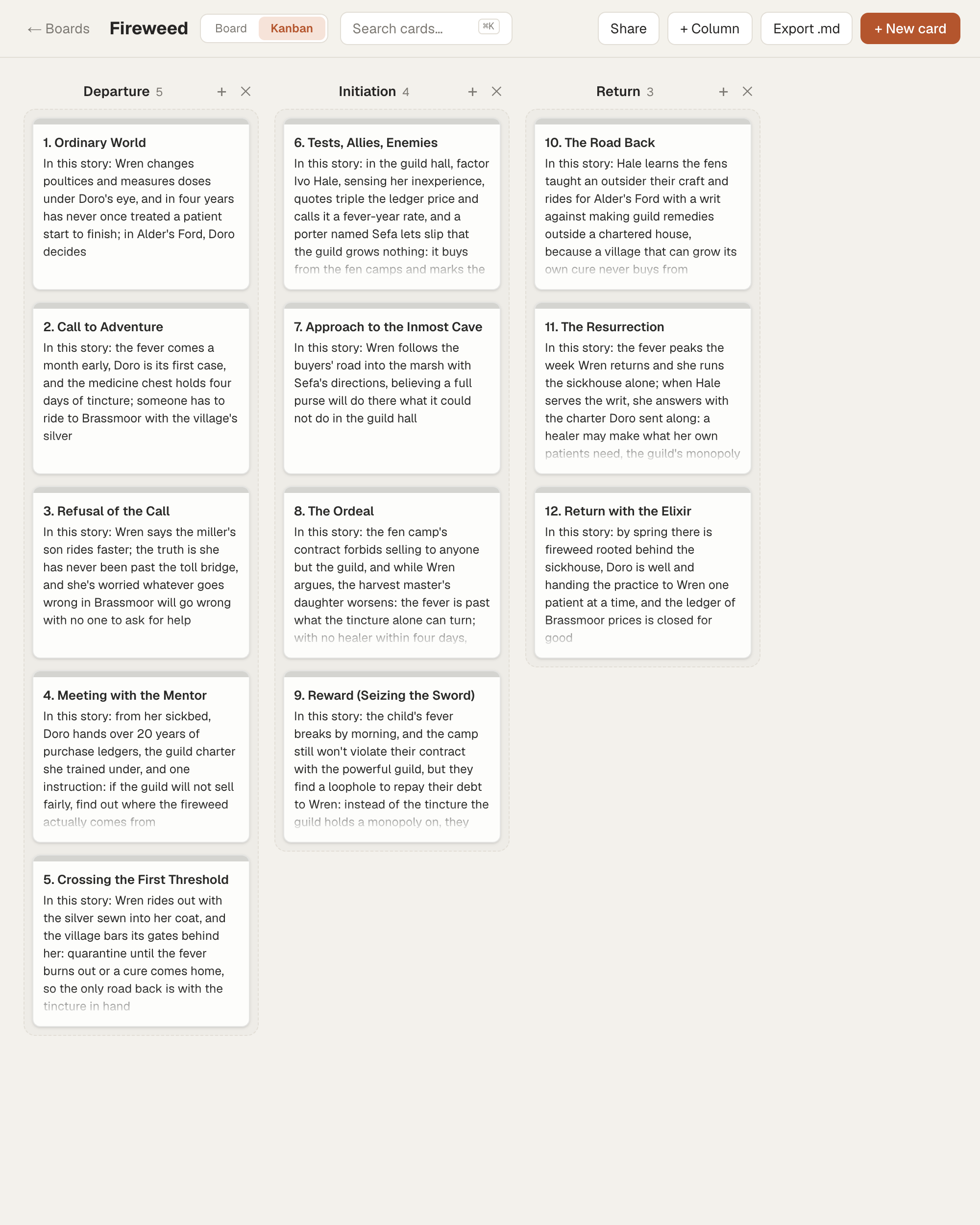
Kanban columns, one per movement. Name three columns Departure, Initiation, and Return, then drop in five cards, four, and three.
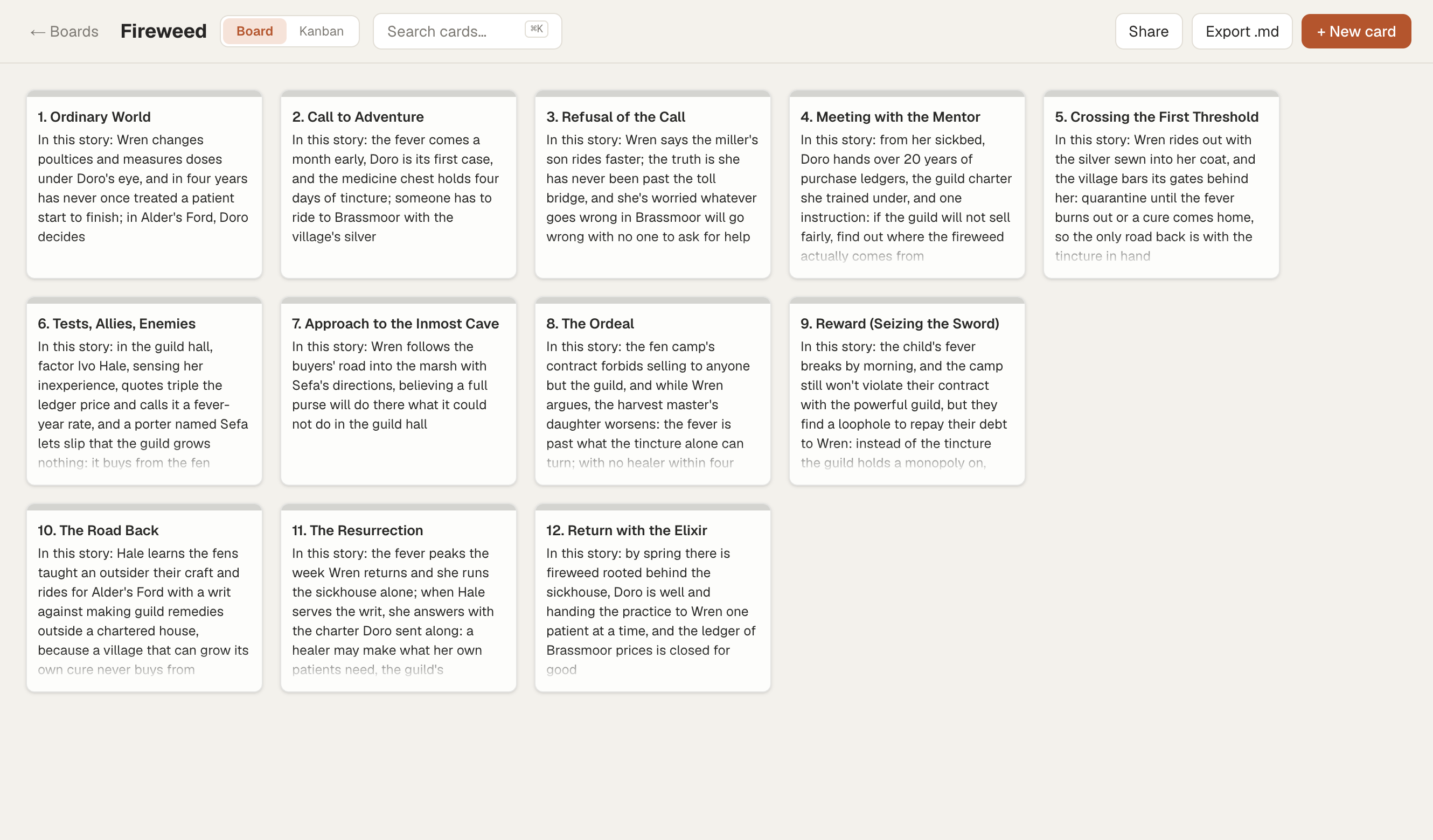
Corkboard rows, one per movement. The free-form corkboard view snaps cards to a grid, so use three rows that read left to right in order. This suits the stage where you are still moving stages around, and it lets you stack scene cards under the stage they serve.
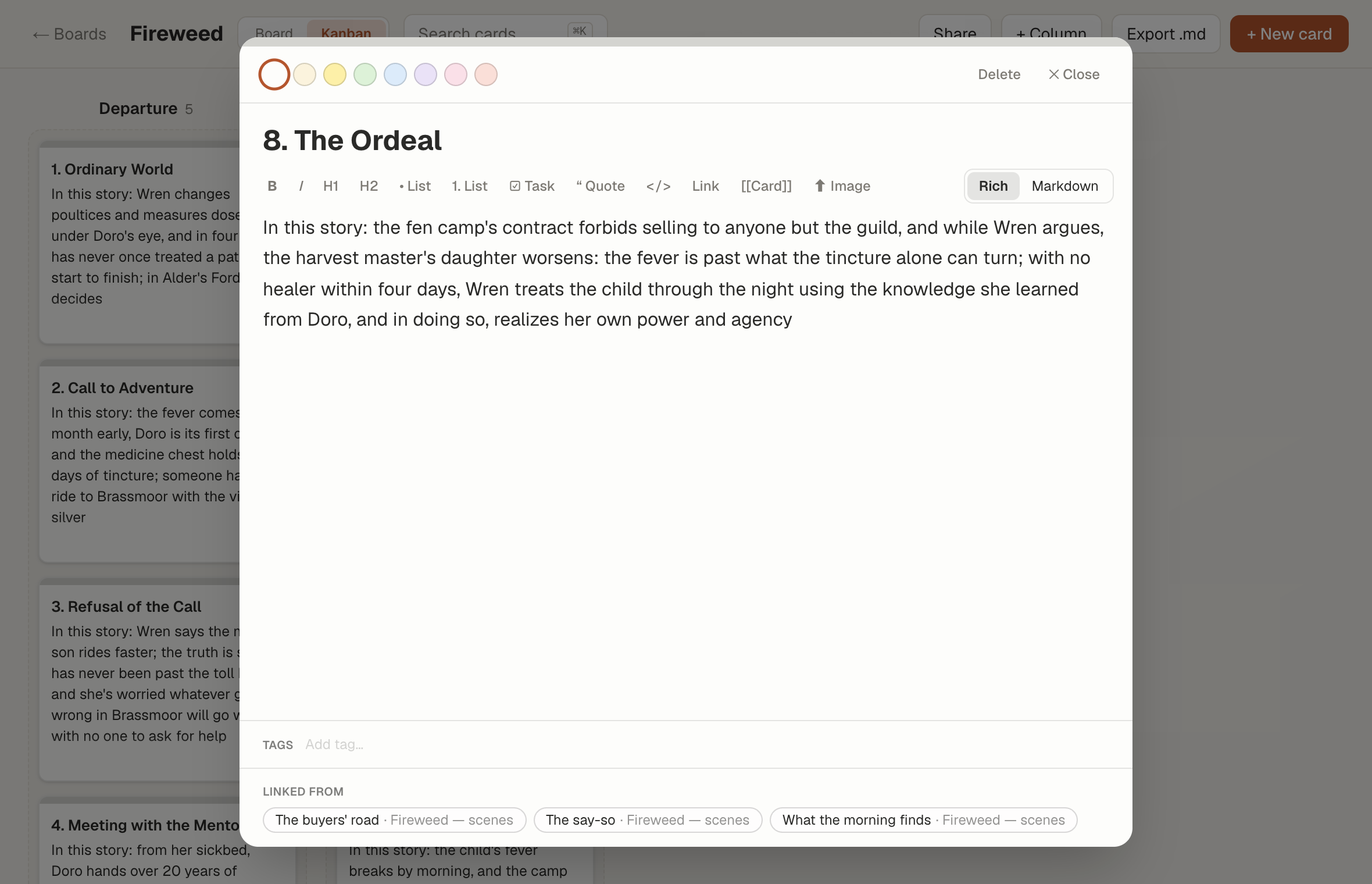
Then expand. Each stage card becomes a small pile of scene cards built from the five fields in our guide to scene cards: a title, the point-of-view character and time, the want, the turn, and the hook. Stack them under the stage card, or put scenes on their own board and drop a wiki-link like [[8. The Ordeal]] into each one, so opening the Ordeal card collects every scene pointing at it in its backlinks. Tags let you mark stage cards with one tag and scene cards with another, then filter down to the 12 for the aerial view.
An example: Fireweed
Let's put a story through all 12 stages, so you can see how it unfolds.
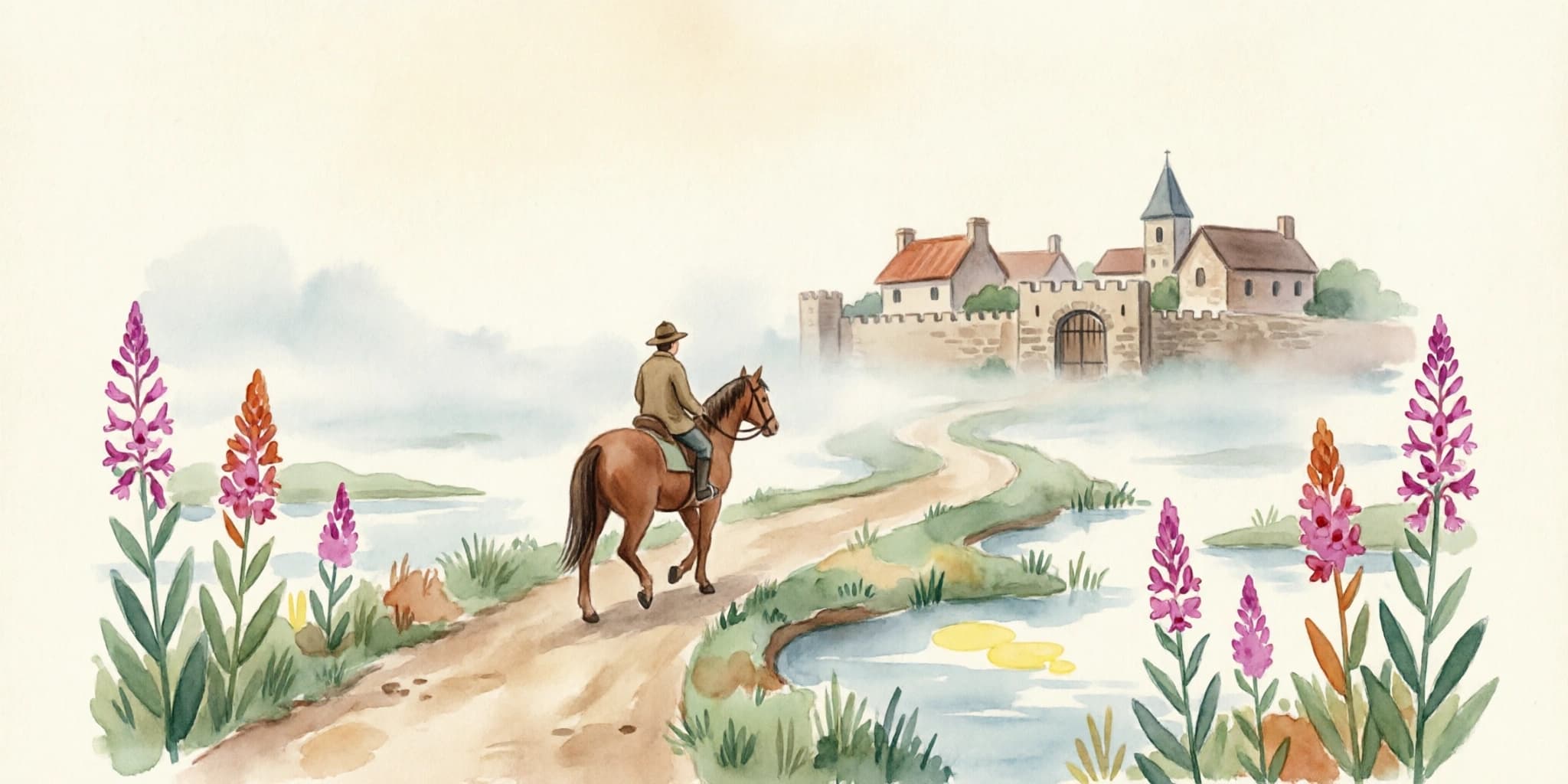
Premise: The marsh fever comes to Alder's Ford every autumn, and every autumn the village buys the one medicine that reliably cures it, a fireweed tincture, from the apothecaries' guild in Brassmoor at whatever price the guild names. Wren is the apprentice of the village healer, Doro Mott. This year the fever is a month early, and Doro is its first case.
1. Ordinary World
Movement: Departure
In this story: Wren changes poultices and measures doses under Doro's eye, and in four years has never once treated a patient start to finish; in Alder's Ford, Doro decides
2. Call to Adventure
Movement: Departure
In this story: the fever comes a month early, Doro is its first case, and the medicine chest holds four days of tincture; someone has to ride to Brassmoor with the village's silver
3. Refusal of the Call
Movement: Departure
In this story: Wren says the miller's son rides faster; the truth is she has never been past the toll bridge, and she's worried whatever goes wrong in Brassmoor will go wrong with no one to ask for help
4. Meeting with the Mentor
Movement: Departure
In this story: from her sickbed, Doro hands over 20 years of purchase ledgers, the guild charter she trained under, and one instruction: if the guild will not sell fairly, find out where the fireweed actually comes from
5. Crossing the First Threshold
Movement: Departure
In this story: Wren rides out with the silver sewn into her coat, and the village bars its gates behind her: quarantine until the fever burns out or a cure comes home, so the only road back is with the tincture in hand
6. Tests, Allies, Enemies
Movement: Initiation
In this story: in the guild hall, factor Ivo Hale, sensing her inexperience, quotes triple the ledger price and calls it a fever-year rate, and a porter named Sefa lets slip that the guild grows nothing: it buys from the fen camps and marks the price up
7. Approach to the Inmost Cave
Movement: Initiation
In this story: Wren follows the buyers' road into the marsh with Sefa's directions, believing a full purse will do there what it could not do in the guild hall
8. The Ordeal
Movement: Initiation
In this story: the fen camp's contract forbids selling to anyone but the guild, and while Wren argues, the harvest master's daughter worsens: the fever is past what the tincture alone can turn; with no healer within four days, Wren treats the child through the night using the knowledge she learned from Doro, and in doing so, realizes her own power and agency
9. Reward (Seizing the Sword)
Movement: Initiation
In this story: the child's fever breaks by morning, and the camp still won't violate their contract with the powerful guild, but they find a loophole to repay their debt to Wren: instead of the tincture the guild holds a monopoly on, they sell her root stock, seed heads, and the teaching of how the tincture is made
10. The Road Back
Movement: Return
In this story: Hale learns the fens taught an outsider their craft and rides for Alder's Ford with a writ against making guild remedies outside a chartered house, because a village that can grow its own cure never buys from Brassmoor again
11. The Resurrection
Movement: Return
In this story: the fever peaks the week Wren returns and she runs the sickhouse alone; when Hale serves the writ, she answers with the charter Doro sent along: a healer may make what her own patients need, the guild's monopoly covers only trade, and nothing in Alder's Ford is for sale; he rides home with nothing to enforce
12. Return with the Elixir
Movement: Return
In this story: by spring there is fireweed rooted behind the sickhouse, Doro is well and handing the practice to Wren one patient at a time, and the ledger of Brassmoor prices is closed for good
Now open one stage into scenes. The Ordeal is three scenes, held together by one want: Wren wants the cure bought and paid for, without the responsibility of looking after the sick.
The buyers' road
POV: Wren · Day 12
Where: the fen camp's gate, at dusk
Wants: to trade the village's silver for a fair price and be gone by morning
Turn: the harvest master turns her away; the camp's contract with Brassmoor forbids selling to anyone else, and the guild is the only buyer they have
Hook: from the drying shed, a child coughs the way Doro coughed the morning Wren left
The say-so
POV: Wren · Night of Day 12
Where: the harvest master's tent
Wants: someone, anyone, with more right than her to treat the girl
Turn: the camp's remedy has already failed, the nearest healer is four days back down the road, and the girl's mother is looking at Wren
Hook: Wren has never once dosed a patient without Doro checking the measure first, and there is no Doro for four days in any direction
What the morning finds
POV: Wren · Day 13
Where: the drying shed, before dawn
Wants: to hold the doses steady through the worst of it without Doro's hand on her shoulder
Turn: at first light the fever breaks, and the harvest master asks what the camp owes her
Hook: Wren answers with the only price that saves Alder's Ford for good: teach me to make it
Follow the chain. The camp's contract is why silver cannot buy the cure, the sick child is why Wren finally treats a patient start to finish, and the broken fever is why the camp owes her a debt money could not create. The teaching she asks for is the Reward, and Hale's writ on the Road Back exists because she asked for it. Each turn produces the next scene's problem.
Where does the Hero's Journey stop helping?
The pattern has serious critics, and their objections are worth knowing before you build a book on it.
Campbell chose the myths that fit. Folklorists have pointed out that he worked from a selection, summarized loosely, and set aside stories that did not match. The monomyth reads as universal partly because the exceptions were left out.
The hero is almost always a man. Campbell's stages include Meeting with the Goddess and Woman as the Temptress, both of which cast women as encounters the hero has rather than people on journeys of their own. Maureen Murdock, who studied with Campbell, concluded that the model did not describe women's lives and wrote The Heroine's Journey in 1990 as an alternative.
Not every story is a quest. The pattern assumes a character who leaves. Many novels are about someone who stays: a marriage, a house, a town, a job, a year. You can certainly force those books through 12 stages, but it won't always work well.
It has been worn out. Vogler's memo went through Hollywood, and the shape it produced became the default for 30 years of films. It may not be the best path to telling a unique story.
Use the 12 stages as starting points rather than requirements. A stage you cannot fill is information about your book, and sometimes it tells you the book is not this shape.
Try it
Write the 12 stage names on index cards and fill in what your story does at each one. Start with the Ordeal and Return with the Elixir, because those two decide the rest.
If you want a board you can rearrange, link scenes and stages, and edit on any device, Cork is free to try: three boards on the free plan, no credit card required.