How to overcome writer's block
What writer's block usually is, how to tell a story problem from a standards problem from plain exhaustion, and the techniques that get you writing again.
To overcome writer's block you first need to figure out which kind of block you have, because the three common causes need three different fixes. If you cannot say what happens next, the problem is in the story, and the cure is outlining work rather than more staring at the page. If you know exactly what happens and still cannot type it, the problem is your standards, and the cure is permission to write a bad version. If you cannot summon interest in any of it, you are out of energy, and the cure is rest and new input.
This guide covers what writer's block is, how to tell the three causes apart, the specific fix for each, and the techniques writers reach for regardless of cause.
What is writer's block?
Writer's block is being unable to produce new work while wanting to, for reasons that have little to do with skill, time, or knowing your craft.
The term came from the psychoanalyst Edmund Bergler, who wrote about blocked writers in the 1940s and treated the condition as a single neurosis. Later research expanded with additional nuance. In the 1970s and 1980s the Yale psychologists Jerome Singer and Michael Barrios studied blocked writers across fiction, poetry, and screenwriting, and found more than one kind of blocked writer: some anxious and self-critical, some resentful of comparison to other writers, some flat and disengaged. Maria Konnikova's account of that research in The New Yorker digs deeper.
The practical lesson from all of it is that "writer's block" names a symptom rather than a cause. Two writers can both be stuck at chapter 12 for reasons that have nothing in common, which is why one writer's advice so often does nothing for the next one.
What kind of stuck are you?
Here are the three causes writers run into most, with the tell for each.
A story problem. You sit down and genuinely do not know what happens next, or you know what happens but cannot see why the character would do it. The page is blank because the story is blank. This is the most common form and the most fixable.
A standards problem. You know exactly what the scene contains. You can describe it out loud in 30 seconds. The moment you try to write the actual sentences, everything you produce reads as worse than what you imagined, so you delete it and try again. Nothing accumulates.
An energy problem. The story is fine, your standards are the usual ones, and you cannot make yourself care. Reading feels like work. This is the one that gets pushed through hardest and responds to pushing least.
Here is a question that sorts them quickly:
Imagine a friend offers to write your next scene for you tonight. How do you feel?
- Relief means it is a standards problem.
- Having no idea what you would even tell them to write means it is a story problem.
- Not caring whether they do it means it is energy.
Diagnose before you reach for a technique. Timed sprints will not save a scene that has no reason to exist, and a fresh outline will not help a writer who needs a week off.
How do you fix a story problem?
Stop trying to write forward and start laying out what you already know.
Get everything solid about the book out of your head and onto index cards: the scenes you are sure of, the ones you have already drafted, the ending if you have it, the character decisions you consider settled. Do not try to order them at first. Just get them all out where you can see them.
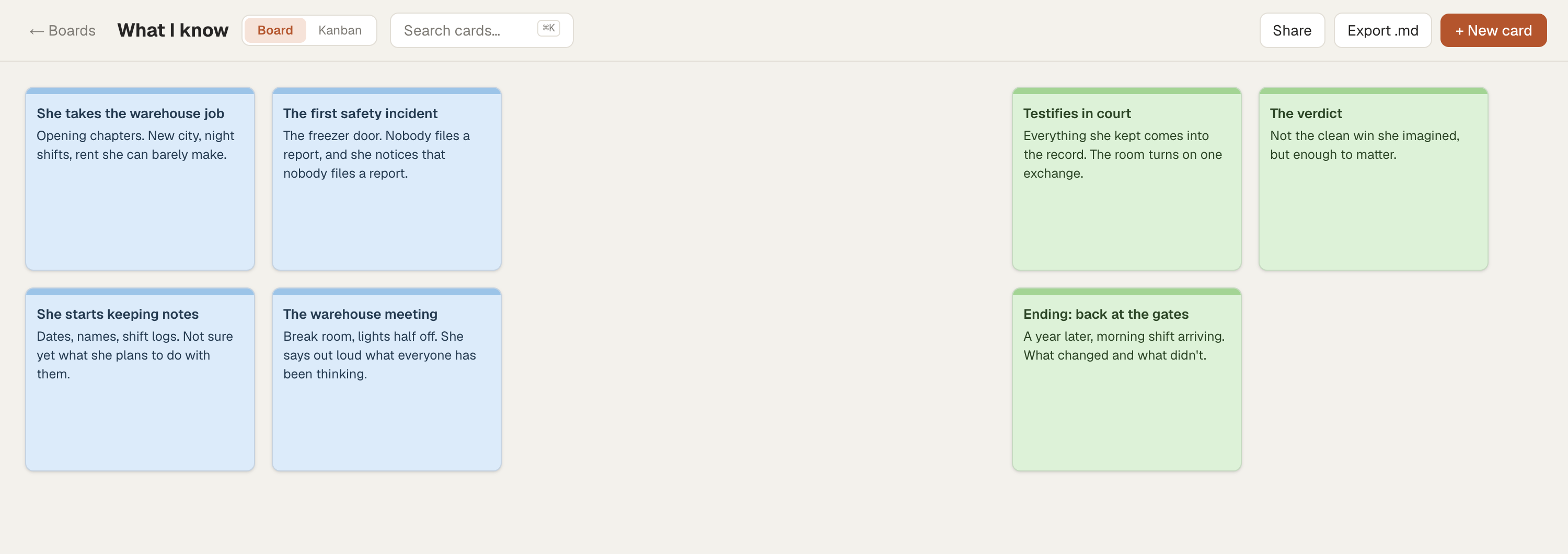
Any issues will show up on their own. A board full of cards with a hole in the middle tells you something a blank page cannot: your character is in the warehouse in one card and testifying in court on the next, and there is no card explaining how she got from the first to the second. That missing card is what was blocking you the whole time.
Here are two follow-ups once the gap is visible:
Check the scene's parts. Most unwritable scenes are missing one of the five things in our guide to scene cards: a title, the point-of-view character and time, the want, the turn, and the hook. A scene where nobody wants anything cannot be written by anyone. Fill in the want and the scene usually opens.
Rearrange rather than invent. Sometimes every card is fine and the order is wrong, and the scene resists being written because it has been asked to do a job that belongs 40 pages earlier. Drag the cards into a new sequence and read the board top to bottom. Our guide to outlining a novel with index cards covers reading a board for structural trouble. If the hole turns out to be larger than one scene, back up to a shorter summary and rebuild from there, which is the whole logic of the snowflake method.
Cards help here for a structural reason. A card holds one idea, so a set of cards makes the shape of your thinking visible in a way that paragraphs of notes never do. Add a tag like unresolved to the cards you are unsure about, filter to just those, and you have a list of the actual open questions in your novel.
How do you fix a standards problem?
Lower the stakes on purpose.
Anne Lamott's Bird by Bird introduces her idea of terrible first drafts: nobody produces good prose on the first pass, the first pass exists only to get material on the page, and the good version is something you find later by revising the bad one. Writers who cannot start are usually trying to skip the pass that everyone has to do.
Here are four ways to make that concrete.
Write the bad version deliberately. Give yourself the goal of writing the scene badly. Flat dialogue, placeholder descriptions, [fight goes here] where the fight goes. A bad or incomplete scene can always be revised.
Change the unit of work. "Write chapter 12" is a job with no obvious bottom. "Fill in one card" takes 10 minutes and has a clear stopping point. Make the next thing you owe yourself small enough that refusing it feels sillier than doing it. A card body in Cork holds full markdown, so a card can grow from one line to several hundred words without the pressure of needing to be a "chapter."
Write out of order. There is no rule that scenes must be drafted in the sequence readers meet them. Skip the scene that is fighting you, write the one you are excited about, and come back. The stuck scene is often easier once the scene after it exists, because now you know what it has to deliver.
Stop mid-sentence. In his Paris Review interview, Ernest Hemingway described stopping each day at a point where he still knew what came next, so that starting the following morning meant finishing a thought rather than inventing one. Try it literally: quit in the middle of a sentence. Tomorrow's blank page will not be blank.
Standards problems tend to come back, so treat these as habits rather than emergency measures.
How do you fix an energy problem?
Rest, and be honest about what counts as rest.
Scrolling on the couch for two hours does not restore the thing writing uses up. Real recovery usually means sleep, exercise, time outdoors, and being around other people. It also means input: reading books in your genre and outside it, seeing films, going places, having conversations you did not plan. A drained writer is often a writer who has spent months producing without taking anything in.
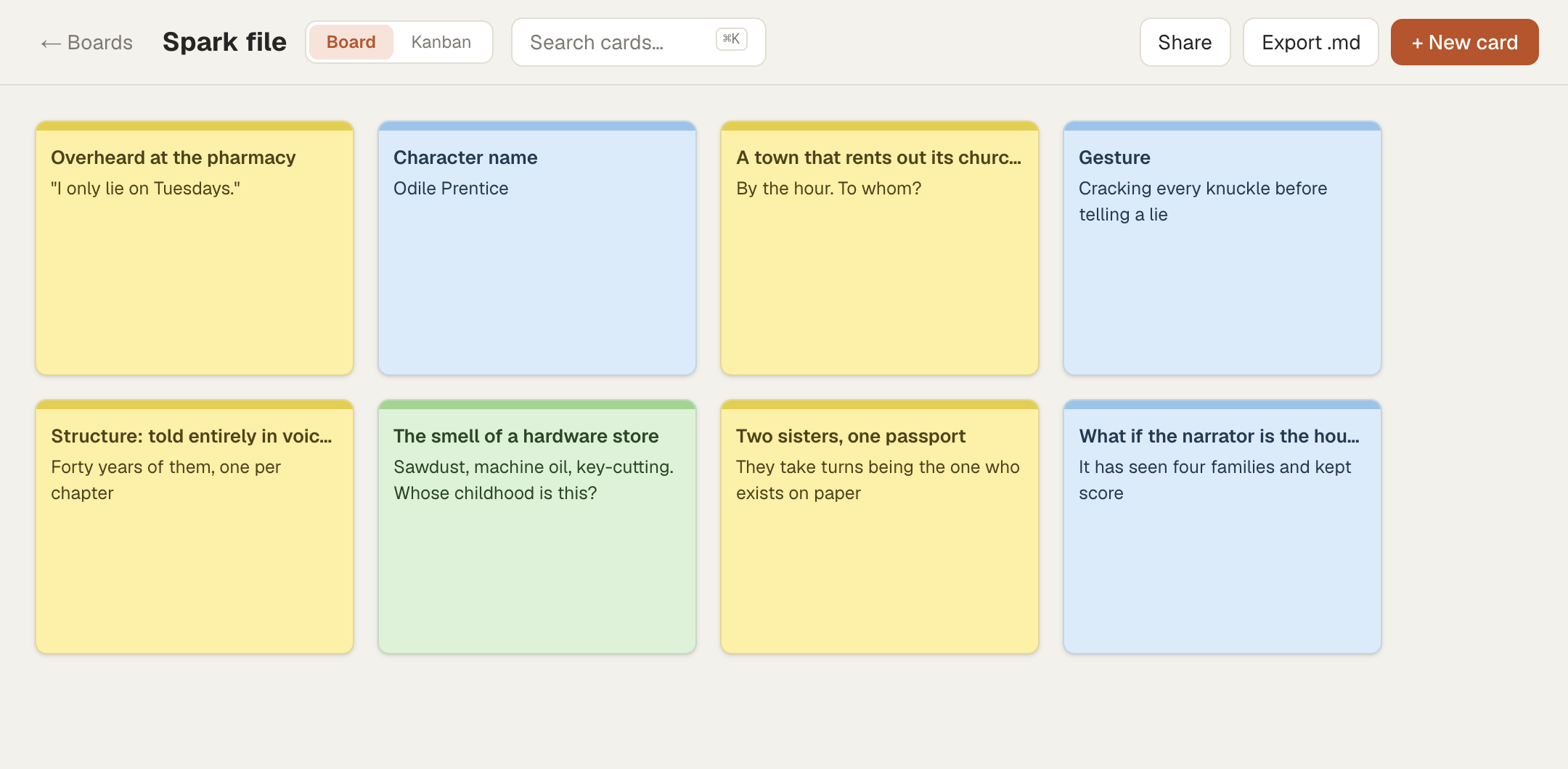
While your energy comes back, do collecting work rather than drafting work. Keep a spark file, a term the writer Steven Johnson uses for a running document of every stray hunch, which he rereads every few months to find connections that were invisible the first time. A Cork board works well for this because each idea gets its own card and the set stays scannable. Overheard lines, a character name, an image, a gesture, a structure you admired in someone else's book. Use card colors to separate ideas for the current project from ideas for later, and search when you need to find something again.
Collecting keeps you in contact with the work without demanding output, and it gives your next project a running start. Set a date to check back in, then actually keep yourself from rereading your spark file until then.
Techniques that help whatever the cause
A few things are worth trying no matter which diagnosis you landed on.
Prompts and timed sprints. A prompt gives you something to write that carries no consequences for your novel, which is often enough to get your hands moving. Sprints work the same way by putting a wall around the effort: 15 minutes, no stopping, no editing, and no judgment about what comes out. If you need prompts, our free prompt generator, Quick Prompts, will produce as many as you want. Sprint with other writers if you can find them, because the mild social pressure genuinely helps.
Talk the scene out loud. Describe the scene to a friend, or to a voice recorder, or to an empty room. Speech runs on different equipment than prose and rarely stalls the same way. Many writers can narrate a scene fluently 60 seconds after failing to write its first line, and the recording becomes your first draft (even if it might be a terrible one!).
Move to paper. Handwriting is slower and messier, and both of those can help. You can't delete a sentence three words in, and nothing looks finished enough to judge. Fill a page, then type it up.
Change where you sit. The desk where you have failed for two weeks now has failure attached to it. A library, a coffee shop, a park bench, or a different room can break the association. It is a cheap trick, but it often works.
Set a floor rather than a target. A daily goal of 1,000 words is a way to fail. A daily floor of 100 words is a way to start, and most days you will write more once you have begun.
Sometimes the fix is a walk
Software helps with story problems and does little for the other two. If you are burned out, the most productive thing you can do is close the laptop and go outside. If you are afraid of your own sentences, that fear does not live in a tool, and no tech stack will resolve it for you. Plenty of blocks clear up after a long walk, a full night's sleep, or a conversation with someone who has read your work and offers encouragement.
Give the non-writing fixes the same respect you give the writing ones. A week away from a novel costs a week. A year of grinding at a book you resent can cost the book.
Try it
Take 20 minutes and run the diagnosis. Write what you know about the stuck section on cards, one idea each, and see whether a gap appears. If it does, you had a story problem and now you have a path toward a fix. If the board is complete and you still cannot write, it was never about the story, so pick the smallest possible next step or take a real break.
If you want a board you can rearrange, tag, and search, Cork is free to try: three boards, no credit card required.