How to prepare for NaNoWriMo using index cards
What to prepare in October for 50,000 words in November: a premise, characters with wants, a few landmarks, and a scene bank on index cards.
Each November, thousands of writers participate in NaNoWriMo, short for National Novel Writing Month, challenging themselves to finish a 50,000-word novel draft in just one month. Though the organization behind NaNoWriMo is no longer operating, many writers still attempt the November novel writing challenge.
For many writers, a successful NaNoWriMo hinges on using October to decide enough about their novel that they can write 50,000 words of it in November without stopping to work out what happens next. For most writers that comes down to four things: finding a premise you can say in a sentence or two, choosing main characters who want something, having a rough shape with a few landmark moments in mind, and compiling a large pile of scene ideas. Index cards suit this work well because while doing this type of prep you'll likely rearrange things many times, and a card (especially a virtual one in Cork) can be moved, split, or be set aside without disturbing anything around it.
Is NaNoWriMo still happening?
Yes, though without the organization that used to run it. The NaNoWriMo nonprofit shut down in March 2025 after a run of moderation controversies and backlash over its position on AI. Its website, forums, and word counter went with it.
The event itself carries on, run by the community. The goal is the same: draft 50,000 words of a novel between November 1 and November 30. Here are the main ways to take part:
- Novel November. ProWritingAid runs this free challenge, and it is the closest thing to a successor to the old event.
- Reedsy's November challenge. Reedsy runs its own 50,000-word challenge during the month.
- On your own or with a local group. Plenty of writers pick the goal, tell a few friends, and start on November 1. Some local groups that formed around the old event still meet for write-ins.
None of this changes how you prepare. The advice below works for any version, including doing November alone (or challenging yourself in any other month of the year).
What to prepare in October
Many writers refer to October as Preptober, because of the pre-work you can do to set yourself up for NaNoWriMo. The aim is to arrive on November 1 knowing enough to keep writing every day. That usually takes less planning than a full outline and more scene ideas than you'd expect.
Some quick arithmetic helps set the target. Fifty thousand words over 30 days works out to 1,667 words a day. If your scenes tend to run 1,500 to 2,500 words, a 50,000-word draft holds somewhere around 20 to 35 scenes. You'll want more ideas than that, because some of them will fall apart when you try to write them.
Here's a sequence you can use to make the most of October. To make it easier to follow, we'll see how Deb Harlan, who is prepping a novel she calls Last Show at the Starlite, set at a drive-in movie theater on the edge of a small Nebraska town, gets herself ready to write. On October 1, all she has is the setting and a strong feeling about it.
Week 1: pin down the premise
A premise is a sentence or two that says who your main character is, what they want, what stands in the way, and what happens if they fail.
Deb's first try was "A woman runs her family's drive-in for one last summer." That's a fine starting point, but because nothing is at stake, there is nothing to propel her writing forward. Her second try has a main character (Wendy) with a goal, a deadline, and an opponent:
Premise
When Wendy Pruitt comes home to run her late father's drive-in theater in an attempt to save a meaningful part of her childhood, she has until Labor Day to prove it can pay its way. If it can't, she signs the papers her brother Carl needs to sell the land and save his farm.
If you'd like to grow the premise further, the Snowflake Method expands one sentence into a paragraph and then a page. For NaNoWriMo prep, the sentence is usually enough.
Write your premise on a single card and keep rewriting it until it contains a want and an obstacle.
Week 2: give your main characters wants
Wants are what generate scenes. When a character wants something specific, each attempt to get it is a scene, and so is each thing that blocks them. Answer these three questions for each of your two to four main characters:
- What do they want, specifically enough that you'd know the moment they got it?
- What's in the way?
- What would they never do? Stories tend to push characters toward exactly that.
Here are Deb's three character cards:
Wendy Pruitt
Wants: a season in the black by Labor Day, so she can save the drive-in that means so much to her
In the way: a hail-torn screen, an aging projector, and a town that doesn't remember the charm of a drive-in movie
Would never: tell Carl she has no job to go back to in Omaha
Carl Pruitt
Wants: Wendy's signature before the bank's September 15 deadline
In the way: he can't explain the rush without admitting he mortgaged the farm
Would never: sabotage his father's drive-in
Hector Ruiz
Wants: to keep the Starlite open, because running the projection booth is the only job he's ever had
In the way: he's been paying for repairs out of his pension, and the money is almost gone
Would never: ask the Pruitts for help
Notice how the wants collide. Wendy and Carl want opposite outcomes for the theater, and Hector wants what Wendy wants but is hiding his own dire situation. Collisions like these tend to produce scenes with little effort.
Give each main character one card, and make each want concrete enough that you can picture someone acting on it.
Week 3: sketch a handful of landmarks
A rough shape gives you something to write toward without locking you into an order. Five landmarks are plenty: an opening, a turn at the end of act one, a midpoint, a low point, and an ending. For deeper structure work, see outlining a novel with index cards.
Deb wrote one card per landmark:
Hailstorm
A week before opening night, hail shreds the screen, and Carl slides the sale papers across the snack bar counter.
Wendy won't sign
She promises Carl the Starlite will turn a profit by Labor Day, and he agrees to wait until then.
Fourth of July sellout
A double feature fills every space in the lot, and the Starlite makes money for the first time in years.
The projector dies
On opening night for a big new blockbuster in August, the screen goes dark halfway through the second film, and the crowd leaves honking.
Labor Day
The season's last show ends, and Wendy has to decide whether to sign.
Each landmark comes out of a want. Carl pushes the papers because he needs the signature, and Wendy refuses because she needs the season. Deb hasn't decided why the projector dies: Carl could be breaking his own rule, or Hector's money could have run out. She doesn't need to settle that in October, and the board section below shows how she keeps both options.
Stop at five or so landmarks and spend the rest of October on the next step.
Week 4: fill the scene bank
This is the piece of prep that will do the most for you in November.
A scene bank is a pile of scene ideas, one per card, that you can draw from in any order while you draft.
A scene bank card needs a title and a line or two about what happens. Fuller scene cards with the point of view, the turn, and the hook are useful, but you can add those details as you draft. Based on the arithmetic above, 40 or more cards leaves plenty of room for ideas that don't survive.
The quickest way to generate cards is to go back to your character cards. For each character, list every way they might try to get what they want and every way someone else might block them. Deb's pass on Wendy's want produced cards like these:
Dollar-a-carload night
To fill the lot on a slow Tuesday, Wendy charges a dollar a car. Ninety cars show up with their own coolers and buy nothing at the snack bar.
Selling the preshow
Wendy goes door to door on Main Street selling ads for the preshow reel, and the hardware store owner asks why he'd advertise at a place that's closing.
Her pass on Carl's want gave her this:
The surveyor
Carl walks the buyer's surveyor across the lot during a sold-out Saturday show, so Wendy will see the sale is real.
And Hector's secret turned into this:
Hector's receipts
Wendy finds repair invoices in the booth drawer, all paid in cash, and realizes Hector has been keeping the Starlite running with his own money.
Smaller ideas go in the bank too: an image, a line of dialogue, a moment that doesn't belong anywhere yet. By the end of October, Deb has 46 cards.
Add cards to the bank every day of the last week, and don't judge them yet. Sorting comes later.
Building your prep board in Cork
Everything above fits on one board, which keeps the whole novel in view at once. In Cork, each card has a title and a body; the board shows titles at a glance, and clicking a card opens it in a full-screen editor.
Here's how Deb laid out her board:
- Top row: the premise card, followed by the five landmark cards from left to right.
- Left side: the three character cards, stacked vertically.
- Everything else: the scene bank, loosely grouped by act.
Colors for point of view. Cork gives you eight index-card colors plus a custom color picker, covered in the card basics. Deb made Wendy's cards blue, Carl's green, and Hector's yellow. Stepping back, she can see at once that Hector has only four cards. The premise and landmark cards get a color of their own.
Tags for acts and roles. Colors handle one kind of grouping, so tags take care of the rest. Deb tags every card with act-1, act-2, or act-3, and adds landmark to the five landmark cards. Filtering by act-2 showed her only nine cards in the middle of the book, which is where many November drafts stall. She spent an evening adding more.
Stacks for decisions you haven't made. When you have two versions of the same scene, write both and pile them together. Cork lets you stack cards into piles, as described in arranging cards. Deb stacked two versions of her low point:
The projector dies (Carl)
Carl pulls a fuse in the booth during the August show, meaning only to stall one night's receipts, and the old wiring fails for good.
The projector dies (worn out)
The lamp burns out mid-film, and Hector has nothing left in the pension to pay for another.
Whichever version she favors sits on top. She did the same with her ending, stacking a card where Wendy signs next to one where she doesn't.
Links from scenes to characters. In the body of each scene card, Deb adds a link to the character card, such as [[Hector Ruiz]]. Hector's card then shows a backlink to every scene he appears in, which is a fast way to check whether a subplot vanishes for a stretch of the book.
You can also use Cork on your phone, so an idea you have in line at the grocery store can go straight into the bank.
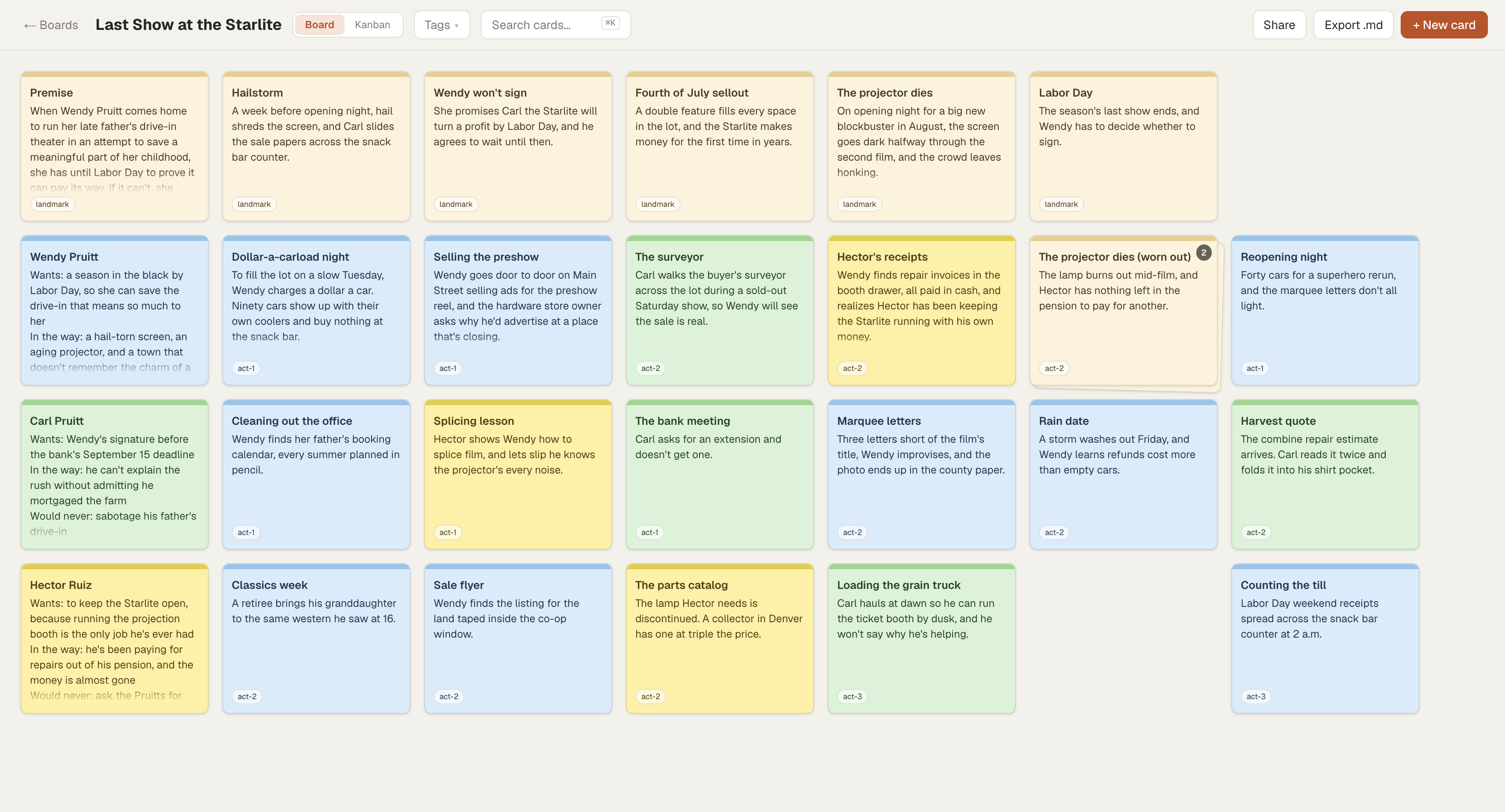
Build the board with one card per idea, color by point of view, tag by act, and stack any choice you haven't made yet.
Using the board during November
On November 1, the scene bank turns into a queue. Each day you open the board, pick a card, and write that scene.
Cork boards can switch to a kanban view, which suits this well. Set up three columns: Scene bank, Drafting, and Drafted. Drag a card to Drafting when you start it and to Drafted when you finish, and the columns show what's written and what's still waiting.
You don't have to draft in order. When you're stuck, pull any card that has some energy for you, even if it belongs in act three. On a bad day in the second week, Deb skipped ahead to "Hector's receipts" because she could see exactly how it played out, and it got her writing again. Cards make out-of-order drafting safe, because the board still shows where each scene belongs, and you can put the pieces in sequence during revision. If a scene needs a bridge you haven't written, leave a bracketed note in the draft, such as "[get Wendy to the booth]", and keep going.
When a scene idea dies, recolor it or tag it rather than deleting it. Deb found "Selling the preshow" went flat twice, so she tagged it cut and used the custom color picker to turn it pale gray. Filtering hides it from the queue, and search will find it again if it fits somewhere later. New ideas that turn up mid-draft go straight into the Scene bank column.
Cork doesn't track word counts, so keep your daily numbers in whatever tracker or spreadsheet you like alongside the board. TrackBear is a free tracker built for goals like this one.
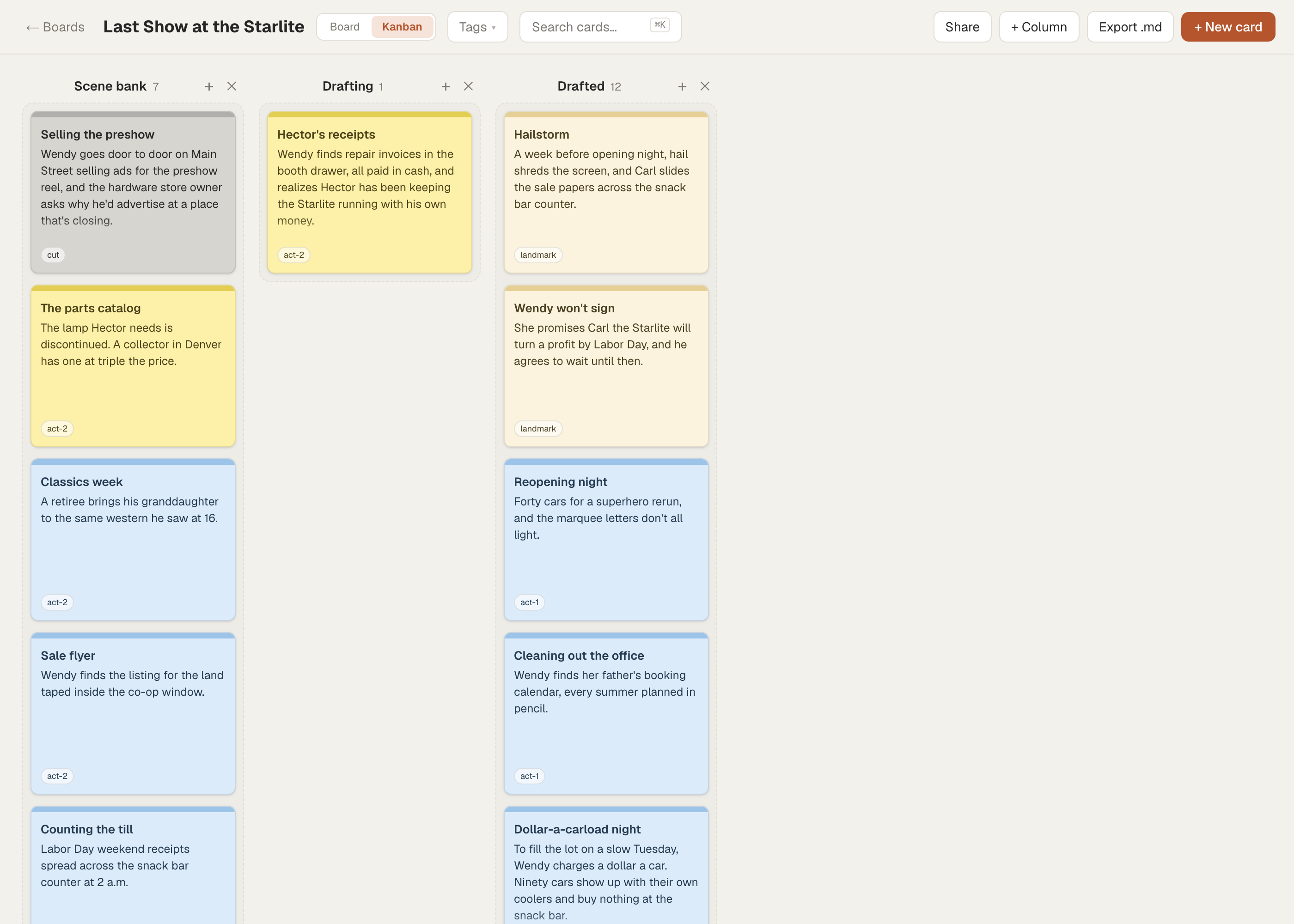
Here's a daily routine that works well with the board:
- Open the board and pick a card from the Scene bank column.
- Drag it to Drafting and open it full screen to read what you planned.
- Write the scene.
- Drag the card to Drafted and log your words in your tracker.
- Add a card for any new idea that turned up while you were writing.
What you have on November 1
A writer who follows this plan starts November with a premise on one card, a card for each main character with a want that generates scenes, five landmark beats to write toward, and 40 or more scene ideas colored by point of view and tagged by act. Open decisions sit in stacks instead of blocking the draft. Most mornings in November, the question of what to write next already has an answer waiting on the board.
If you start in the first week of October, give each step an evening or two, and use the rest of the month to keep adding cards to the scene bank.
If you want a prep board you can build in October and draft from in November, Cork is free to try: three boards, no credit card required.