Plotter vs. pantser: which kind of writer are you?
What plotters and pantsers actually do, where the terms came from, the honest trade-offs of each approach, and how to work out which one suits you.
A plotter is a writer who works out the story before drafting it, usually in some kind of outline that says what happens and in what order. A pantser is a writer who begins with much less, often a situation, a character, or an opening image, and finds the story while writing it. The name comes from the expression "flying by the seat of your pants," and the same approach is also called discovery writing. Both are working methods rather than skill levels, and many writers use some of each.
This guide covers where the terms came from, pros and cons of each method, how to tell which way you lean, and how index cards fit into either approach.
Where do the terms "plotter" and "pantser" come from?
Here's what defines the two styles in their plainest form:
A plotter decides what happens before drafting.
A pantser drafts in order to find out what happens.
"Pantser" borrows from aviation. Before instruments were reliable, pilots read the aircraft through vibration and pressure, feeling the plane through the seat of their pants, and the phrase for flying that way spread into general use to mean acting without a plan. Writers picked it up as shorthand, and "plotter" arrived alongside it as the obvious opposite. The pairing has been common in online writing communities for a long time.
George R.R. Martin popularized a gentler version of the same split. In a 2011 interview he described writers as architects, who draw blueprints before driving the first nail, and gardeners, who plant a seed and see what comes up. He returned to the image in a post on his own site, where he says his stories grow and change as he writes them. What makes this framing useful is that all writers are partly one and partly the other, and simply tend toward a side.
If you want a term for the writing you do, either pair works. The distinction is worth understanding mostly because much craft advice assumes one method or the other without saying so, and knowing your lean tells you which advice was written for you.
What does plotting give you, and what does it cost?
Plotting front-loads the thinking. You solve the structure while it is still cheap to change, then draft against a plan.
Brandon Sanderson describes himself this way for most of his books. In his FAQ on outlining and discovery writing he says he usually works as an architect because he has to know where he is going to get the endings he likes, and he notes that outlining is what makes heavy foreshadowing and long series continuity manageable. He also treats his outlines as malleable things that he rebuilds as he writes.
Here's what this approach gives you:
- You hit fewer dead ends, because the sequence has already been tested at summary length.
- Foreshadowing gets easier, since you can view the entire structure at once and plan seeds early for payoff much later.
- Revision tends to be lighter, because big structural problems were caught before you wrote 80,000 words on top of them.
- Deadlines are easier to plan around when you can see how many scenes remain.
But there are costs, too.
The first is execution going stale. If you spent three months settling every turn, the drafting can feel like transcription, and prose written without any curiosity often reads that way. The second is outlining as avoidance. An outline can always be refined, so it makes an unusually comfortable place to hide from the harder job of writing sentences. If your outline has been "almost ready" for two months, that is worth noticing. The third is friction with your characters. A person who felt like a summary on the page can turn out to want something else once they are speaking, and a rigid plan makes that feel like a failure instead of information.
The practical takeaway is that an outline works better as a hypothesis than a contract. Plan enough to trust the shape, then let the draft define its form.
What does discovery writing give you, and what does it cost?
Discovery writing keeps the not-knowing on purpose, because that is where some writers find their best material.
Stephen King is a common example. In On Writing he describes distrusting plot and starting instead from a situation: he puts people he finds interesting into a difficult spot and watches how they get out. He compares stories to fossils being uncovered rather than objects built to a design. The point is not that planning is forbidden, but rather that the interesting answers arrive during the excavation.
Writers who work this way often report that their drafts feel more alive, that dialogue surprises them, and that they stay curious enough to keep showing up.
The costs for pantsers often come later.
Middles sag most often for discovery writers, because the opening runs on momentum, the ending runs on the pressure of finishing, and the long stretch between them has neither. Continuity sometimes slips: a character's brother acquires a different name by chapter 20, and a rule you established at the start gets contradicted at the midpoint. This is especially true for complex stories or ones relying on fully invented worlds. Revision can also be heavier, sometimes much heavier, because the first draft was partly a way of thinking out loud. Some discovery writers also stall out entirely around the 30,000-word mark and start something new instead, which is how people end up with six openings and no book.
The takeaway is that discovery writing moves the structural work after the draft rather than removing it. Plan for that revision instead of being surprised by it.
Almost everyone is somewhere in the middle
You might come across polls on writing message boards asking if you're a plotter or a pantser, but the truth is few writers sit at either pole. Plenty of self-described pantsers know their ending before they begin. Plenty of plotters leave whole chapters in their outline as a vague line with details to be filled in while writing. There is a blended term that circulates online: "plantser," which is rather clumsy, but describes the actual population well.
Sanderson is a good example here too, since he outlines heavily for some books and improvises on others. Many writers work differently depending on the projects. A mystery, where the solution has to be fair to the reader, might use more planning than a character-driven novel about a family.
Your method can also change over time, and often does after a painful revision or an abandoned draft teaches you something about your preferences. Treat your lean as a current setting rather than an identity written in stone.
How can you tell if you're more plotter or pantser?
Answer these three questions to sort out where you land.
What part of writing do you enjoy? Some writers get a real charge from filling in structure, seeing the whole book laid out, and knowing what tomorrow holds. Others find that stage tedious and come alive only when there is a blank page and a scene they cannot predict. Pay attention to which activity you do voluntarily on a good day.
What does your revision process look like? If your second draft is mostly line-level polishing and small fixes, you probably planned enough. If your second draft means rebuilding the order of events, cutting a subplot, and finding the real beginning around chapter four, you are discovering as you go.
What stalls you? The way you get stuck is a strong signal:
- If you stall because you genuinely do not know what happens next, you likely need more planning than you have been doing.
- If you stall because the outline says something and you have lost interest in writing it, you likely need looser planning.
- If you stall because the blank document feels too big to start, the fix is a smaller unit of work rather than a different method.
- If you stall in the middle every time, on every project, that is the sagging-middle problem and it responds well to pinning down the ending at the start.
None of these questions will give you a crystal clear answer. They tell you where you lean right now so you can adjust accordingly.
How do index cards fit into either style?
Cards suit both methods, though they do different jobs.
If you plot, the board is your outline. One card per scene, arranged until the order holds, with the structural work done before you draft. Our guide to outlining a novel with index cards covers building and reading that board, the snowflake method covers growing an outline in passes until it becomes a scene list, and our scene cards guide covers what belongs on each card.
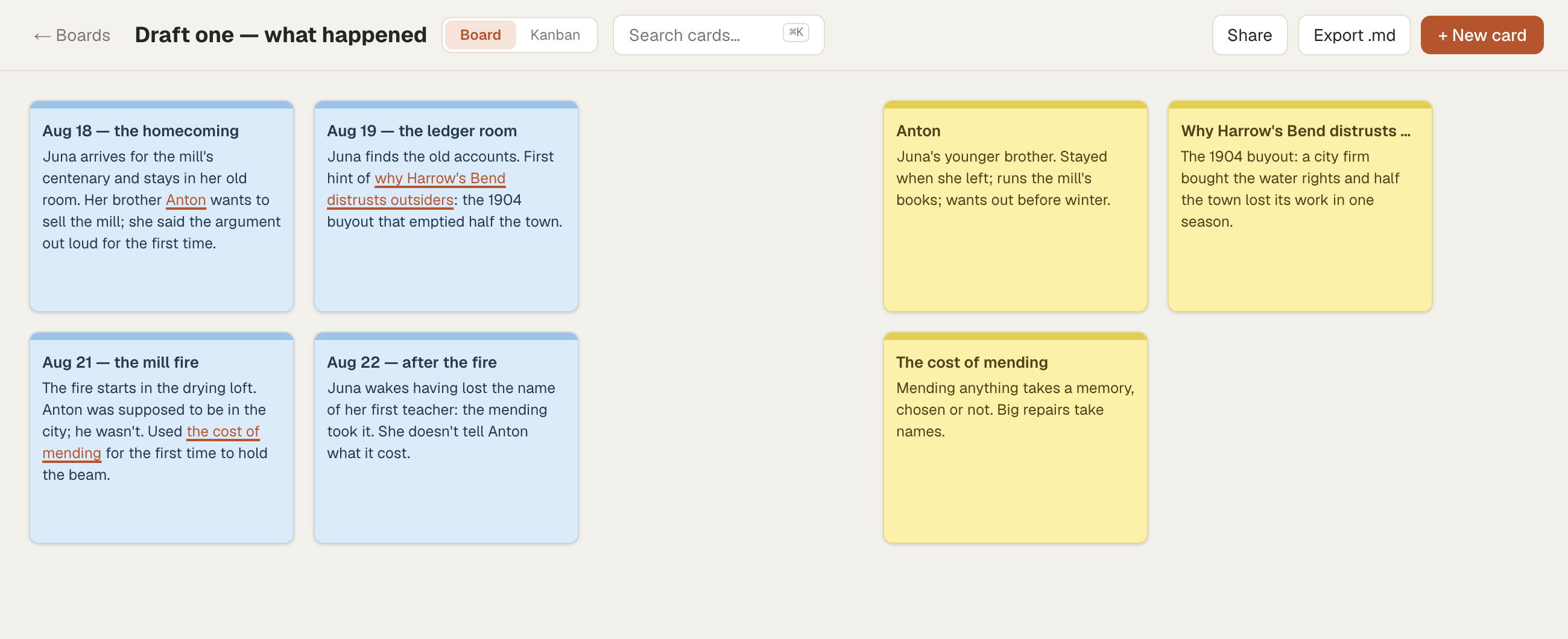
If you discover, use the board after each writing session instead of before. When you finish writing for the day, make a card that summarizes what actually happened, in a sentence or two. Over a few weeks that becomes a record of your own draft that you can scan in a minute, which beats scrolling a 200-page document to remember when the fire happened. The cards look backward at material you already wrote, so they never tell you what to do next.
The same habit handles continuity. When a fact shows up in the draft, especially one that might come up again later, give it a card: the brother's name, why people in the town are so distrustful of outsiders, the rule about how the magic costs something. Wiki-link those cards from the scene cards that mention them, and each fact card automatically collects a list of everywhere it appears. That gives you a working character bible assembled from the draft rather than invented in advance.
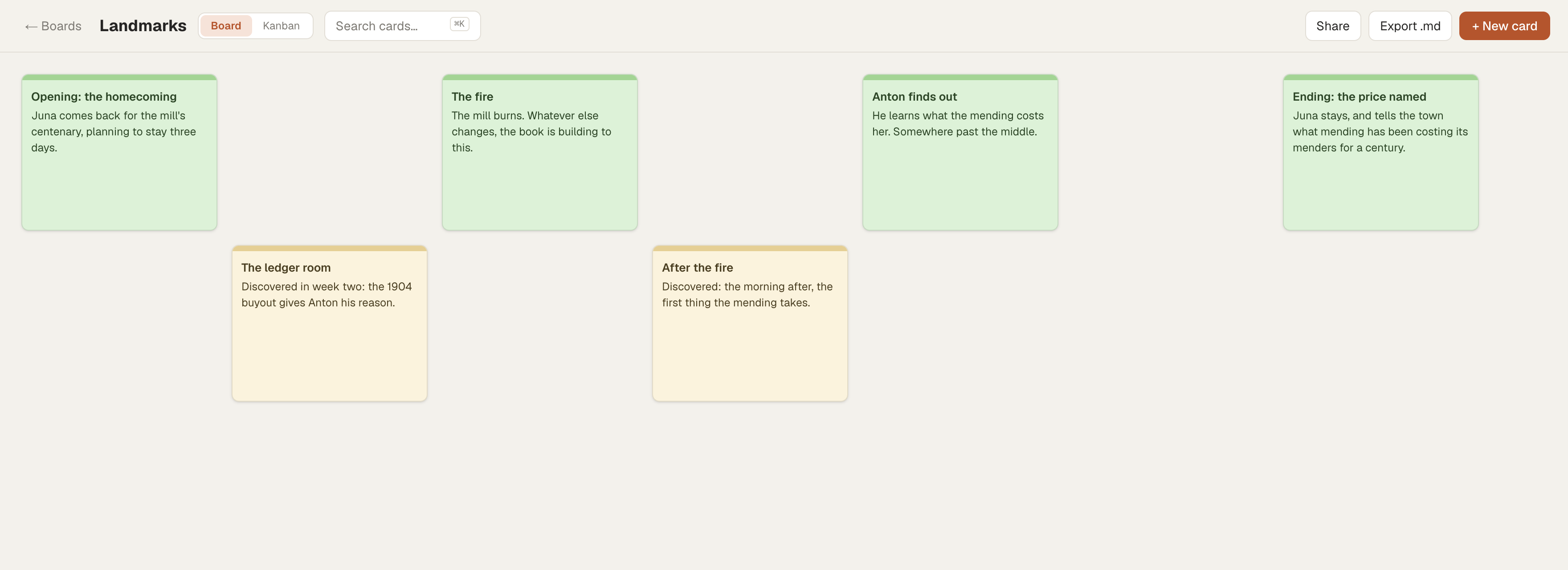
If your style is somewhere in between, pin only the landmarks. The opening, two or three scenes you are sure the book is building toward, and the ending, with open space between them. You keep enough structure to avoid wandering and enough room to find the connecting material while writing. As scenes get discovered, they fill in the gaps between the landmark cards. Card colors are useful here for separating what you have drafted from what is still a guess, and a tag like unsure gives you a filtered list of everything still open.
Whichever way you work, markdown export gets all your notes and ideas out of Cork when you want them somewhere else, and boards you finish can be archived rather than deleted.
When the method is the problem
Some stalls come from using the wrong approach for the book in front of you. A discovery writer forced into a detailed outline can lose interest in a story if they feel too constrained to explore. A planner drafting with no map can spend weeks rewriting the same three chapters. If you have been stuck for a while, try switching methods for a session before concluding the book is broken. Our guide to writer's block covers telling a story problem apart from the other reasons the writing stops.
It's important to remember that there is no winner here. Books get finished both ways, and the method that gets you to a complete draft is the right one for you. You find it by trying both and noticing which one produces pages.
Try it
Take your current project and run one week each way. Spend the first week planning ahead: sketch the next five scenes on cards before you write them, then draft against that. Spend the second week writing with no plan and making cards afterward to record what you found. Compare word counts, and, more importantly, compare how much you wanted to sit down each day.
If you want a board that works for either method, Cork is free to try: three boards, no credit card required.